
I am a Second Generation Descendant of a Holocaust Survivor
by Eleanor Herscher
March 2026
Chapter I • 1925–1938
Early Life in Salzkotten & The Goldschmidt Family
My name is Eleanor Herscher. My parents were Julia and James Grant. This story is about the three of us with a special focus on my mother.
My mother, Julia, was born October 12, 1925, in a small village in eastern Germany called Salzkotten. Her parents were Ella and Julius Goldschmidt. She had a sister, Friedal, who was three years older than she. Jews in Germany faced significant restrictions on their education due to laws and policies enacted by the Nazi regime. When my mother was around ten years old, she and her sister were no longer allowed to attend public school because they were Jewish. More restrictions were imposed on Jews—they had to wear a yellow Jewish star on their clothing so that all the villagers knew they were Jewish and were encouraged to beat, spit and kick them while calling them horrible names.
A group of Nazi soldiers lived in my grandparents’ backyard for a while. During that time, my mother, who was twelve years old, was assaulted by them and told that if she let her parents know what happened, the soldiers would kill her entire family.
It wasn’t until shortly before her death that mom woke up screaming, crying and shaking. When dad asked her what had scared her, she told him what had happened to her when she was twelve. She waited forty-three years to share that haunting memory. When Friedal turned sixteen she fled Germany on a boat headed to what would become Israel. The boat was blown up when it reached the port of Haifa, however Friedal managed to swim to shore.
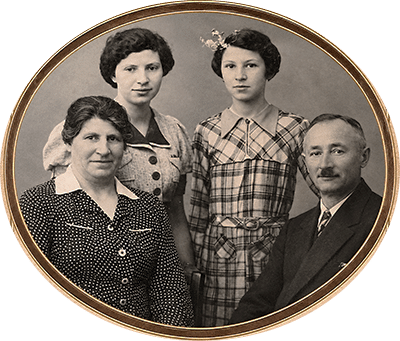
Left: Ella Goldschmidt (grandmother)
Back L: Friedle (aunt) R: Julia (mother)
Front R: Julius Goldschmidt (grandfather)
Chapter II • 1939–1941
Escape from Germany & The SS Mouzinho
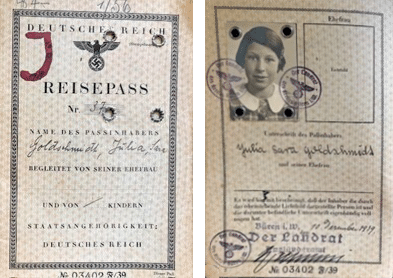
Deutsches Reich Reisepass issued to Julia Sara Goldschmidt, December 1939.
My mother stayed in Germany while her parents were trying desperately to find a way to get her somewhere safe. She was issued a passport on November 10, 1939, and an immigrant visa on May 14, 1941 in Stuttgart. I knew that she had left Europe from Lisbon and was on the last ship leaving Europe with Jewish children on board. Using this information, a friend of mine, Aviyah Farkas, did research and found the manifest for the ship Mom was on, the SS Mouzinho. In the manifest I found my mother’s name and more information. The German-Jewish Children’s Aid, Inc. was established in 1934 with the mission to get as many children out of Germany and to the United States as possible. Between 1934 and 1941 they saved about 1000 children. I have no idea how my mother got to Lisbon from Salzkotten. My guess is that she was part of a group of children that was smuggled out of Germany who walked over a couple of months to Portugal. The SS Mouzinho was the last ship carrying children from Europe to the United States. It was a miracle that my mother was on that boat. It turns out that Marc Chagall was also a passenger. The ship left Lisbon on August 20, 1941, and arrived in New York on September 2, 1941. My mother was fifteen at the time. The rescuers did research and found some distant cousins of my mother in Los Angeles. At first these relatives did not want to take my mom, so she was sent to an orphanage called Vista del Mar. After a while, the cousins decided that she could babysit, cook and clean for them so they took her in. They did allow her to attend and graduate Hamilton High School. It was at this time that my mother was informed that both her parents were murdered in Auschwitz. This caused her to have what she called ‘a nervous breakdown’. She was unable to go to work and spent day after day in bed, crying and sleeping. It took several months but with the help of her extended family and friends she finally started getting better.
Chapter III • 1947–1960's
A New Life in America & Marriage
Her cousin worked in the garment business as a seamstress and talked to her boss about hiring mom. Because my mother was tall, shapely and beautiful, the owner of the business decided that mom could be a lingerie model. In May of 1947, mom went to a Jewish USO dance and met my father. It must have been love at first sight because three months later, they got married. Nine months and two weeks later, I was born.
My father was born in New York City on December 3, 1916. His birth name was Chaim Goldberg. He had five brothers and one sister. He told me his mother worked seven days a week for twelve hours each day. His father was not around very much and did not work. Dad had to navigate his childhood on his own with older brothers who were not kind. His family was very poor. When he was young, he spent part of the summers at a camp for malnourished children. At thirteen he had to quit school and work to help support his family. When the United States joined WWII, my father joined the army. While he was in the service, his family moved to Los Angeles. At the end of the war my father was released from the military, moved to Los Angeles and continued to work in the produce business for his brothers. In May of 1947, my father went to a USO dance for Jewish soldiers. He met my mother, married her, became a husband, and soon after, a father to me, Eleanor Sharon Goldberg.
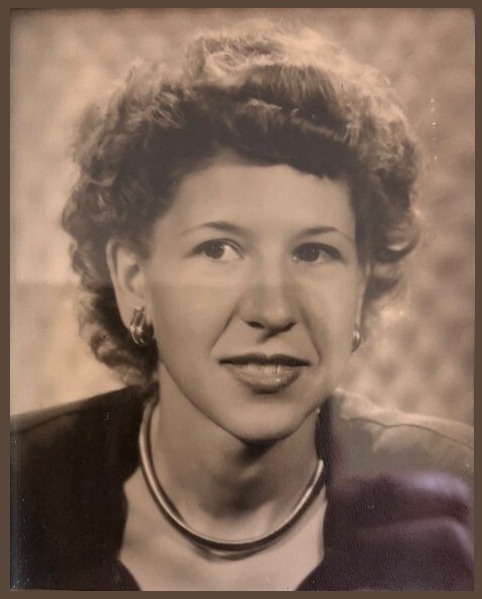
Julia in her early twenties
It turns out that what the Nazi soldiers did to my mother when she was twelve did severe damage to my mother’s insides. It was another miracle that she became pregnant with me. She could not have any more children and at the age of 24 had to have a complete hysterectomy. This was the start of lifelong medical problems for my mother. Along with the medical problems, was the constant reminder that mom had been permanently damaged both physically and mentally by the Nazis. Mom never went to a therapist to talk about her childhood traumas at the hands of the Nazis and her non-Jewish neighbors in Salzkotten. She did not talk to me or my dad about the experiences. The only person she talked to about Germany was her sister (who had moved to San Jose, CA, with her family in 1952). While the sisters talked, I stayed near them, had a book open and acted as though I was reading, but I was really listening and learning about my mother’s life prior to her marriage to my father.
My father learned about radar while in the army. My mother pushed him to go back to school in the evenings to get a GED. After he earned his GED, she continued to support his going to college. He left the produce business and started looking for a job teaching about radar to army recruits. With a name like Chaim Goldberg, my dad could not find a job. He finally realized that he would need a non-Jewish name to find employment with companies that served the military. When I was two years old, my father changed his name to James Grant. With that new name, he found employment immediately. His first job teaching was for soldiers at Ft. Bliss located in El Paso, Texas. We moved often, sometimes three times during my school year. I lived in the following places from first grade till the end of high school: El Paso, TX; Los Angeles, CA; Aiken, SC; El Paso, TX; Savannah, GA; Huntsville, AL; Waltham, MA; Framingham, MA; Philadelphia, PA; Santee, CA; San Diego, CA; West Covina, CA; Los Angeles, CA (for my three high school years). Mom never complained about the constant moving.
Chapter IV • 1979–2026
In the Shadow of the Holocaust & Legacy
While we were in El Paso the first time, mom volunteered for a Catholic orphanage. After several months, mom met and got to know a four-year old girl. I was five at the time. She brought the child home for a weekend. We played and had a great time. Mom and dad wanted to adopt the child. She had a father and he decided he would rather leave her in the orphanage than have her adopted by Jews. This was very painful news, especially for my mother. She had numerous medical issues and over many years became addicted to pain medications. Growing up, I recall several times that she woke in the night screaming. I never received an explanation as to why this happened. As an adult, I realized the terror she experienced in Germany as a child, losing her parents and going by herself to a new country where she did not know the language, had only the clothes on her back and no money, was extremely traumatizing. At fifteen, she was alone in a foreign country. She managed to create a new life, a familly and was very supportive of my dad.
Underneath the surface, my mother was scared. I think that was why she always needed to know where I was and who I was with. When we lived in the South, my mother cleaned houses. During the summers, I would help her clean. I saw how hard she worked and how she was treated. She was an anomaly—southerners were used to black people cleaning. We were poor and mom felt she needed to supplement the money that dad earned.
By the age of eight, I realized what a difficult childhood my mother had endured. I remember thinking at night before I went to sleep that if anything bad was going to happen, let it happen to me and not my mother. She had been through enough in her life.
Once when I was a teenager, my mother and I were walking on Wilshire Boulevard in Beverly Hills. When we reached Beverly Drive, we turned right and there was a man dressed in a Nazi uniform picketing a movie that was playing. My mother stopped, suddenly started screaming and tried to run toward the Nazi, but I held her back. I quickly moved her back to Wilshire Boulevard and tried my best to calm her down. It was so traumatic for her. The thought that there were Nazis in the United States was frightening and reawakened many terrifying memories.
I loved my mother very much. I not only loved her, I liked her, was protective toward her and felt very close to her. When I started my third year of college at UCLA, my mother started inviting a rabbinic student who was studying at Hebrew Union College to our home for dinner now and then. I was forced to cancel any plans I had so that I could be at home on those nights. Both of my parents thought he was special, I didn’t.
When I was twenty, a girlfriend and I went on a short driving vacation to northern California. We stopped in San Jose to stay with my Aunt Fridal. Her husband had a brother who had two sons and also lived in San Jose. One of his sons was the rabbinic student my parents kept inviting over for dinner. We dropped by to see these sons and spent an evening with them. A week later we drove home to Los Angeles.
About a week after returning, I received a call from the rabbinic student asking if he could come over. I replied that my parents weren’t home (thinking that they were who he wanted to see). He said that he still wanted to come over. I remember thinking, how strange. I had just ended a relationship with someone I dated for four years. This breakup left me heartbroken. I was not thinking of a new romance of any kind. The doorbell rang. I opened the door and invited him in. By the end of the evening it was clear that he was interested in me. When I told my mom, she was thrilled. I thought that since he was moving to the Cincinnati, Ohio, campus of HUC in a few days there would be no problem dating him a few times and then it would be over. He was in his fourth year out of a five-year program. I was twenty and he was twenty-seven. When December came, he had a school break and stayed in Los Angeles with friends. My parents invited him for dinner and we went out a couple of times. He seemed nice but I was not falling in love. When he returned to Cincinnati after the break, he started calling me every night. In March, he had another break and again flew to Los Angeles. He asked me to pick him up at LAX. It was evening when he landed. He entered the car on the driver’s side, drove to the beach and parked in a lot overlooking the ocean. Turning to me, he asked me to marry him—not ‘I love you’, just ‘Will you marry me?’ For some reason that I still don’t understand, I said ‘yes’. We went to my parents’ apartment, where I still lived, and told my folks. They were both happy—my father because he could tell people his daughter was marrying a rabbi and my mother because she loved him and felt I would be safe with him.
He returned to Cincinnati after his break. I broke off the engagement the following month. I told him we had had only five or six dates and I really didn’t know him. He pressured me to change my mind. I thought about it and realized that my mother would be totally devastated if I permanently broke up with him. Also I no longer trusted my judgement about men since my painful breakup with my longtime boyfriend. We married three months later. I knew it was a huge mistake but hoped that I would fall in love with him.
We moved to Cincinnati for his last year of rabbinic school. We lived there ten years and had two sons. We finally moved to Los Angeles in June of 1979. Eighteen months later, my mom passed away at the age of fifty-five. She was finally free from her nightmares and demons. It was a life changing event for me. For the first six months after she died, I saw her constantly everywhere I went. She was in the car next to me. She was ahead of me in the checkout line in the grocery store. She was walking in front of me on the sidewalk. I missed her so much. I grew up without grandparents and was so happy that my children had had their grandmother who loved them dearly and now she was gone. I had my two sons to take care of so I didn’t have the luxury of mourning for long.
After mom’s death, I realized that my marriage was over. My husband was never around, had multiple affairs and was emotionally abusive. Within two years of my mother’s death, we separated. A year and a half later, we were divorced. Fifteen years of hell were over and I finally had my freedom. I was able to put myself first because I would no longer be hurting my mother. I took a deep breath and exhaled, knowing I could live my life without worrying about how it would affect her.
I had to move and find a place to live. While doing that, I needed to find a job. I was not allowed to work while married, because I needed to be available for my husband when needed. Thanks to friends, I created a resume. My first job was as a customer software trainer for a medical software company. I loved my job and developed confidence in my abilities. Friends also made me aware that I needed some credit since everything had been in my husband’s name. I came to believe in myself. It felt as though my mother was watching out for me.
Growing up poor was good preparation for life. As a child, I knew not to ask for toys or treats or anything special because we had no spare money. I started babysitting by the age of twelve. I even paid for college with a partial scholarship and by working half time in a doctor’s office. My parents prepared me for life by allowing me to work for everything I had. I was not spoiled and learned how to save money. The holocaust was the backdrop of my life. My mother often told me how lucky I was to have my parents. I have experienced several anti-Semitic incidents during my life and I thought of my mother during and after each one.
Our current government is anti-everything that is not white, male, wealthy and Christian. I am glad that my mom is not here to witness masked hoodlums rounding up people of color, using violence and putting them in detention centers until they are sent out of our country. I firmly believe that if this behavior is tolerated, the masked thugs will eventually include citizens who are homosexuals, Jews, other non-Christians, all citizens with brown or black skin and anyone who disagrees with the reigning dictator. I pray that we do not have another ‘Hitler’.
Thank you for allowing me to share my mother’s story.
Copyright © 2026 Eleanor Herscher. All Rights Reserved.