
Mom
by Deborah Zisovic Beckman
My life is deeply intertwined with the Holocaust. I am the daughter of immigrants and the middle child of two Holocaust survivors, Max and Helen Zisovic. The Holocaust is the mass execution of European Jews between 1933 to 1945 by Nazi Germany. Approximately six million Jews were murdered; two out of three Jews were murdered. My grandparents and other family members did not survive. I became a docent at the Holocaust Museum LA as it is very meaningful to me.
Mom was strong and resilient, fragile and fearful, fiercely loved her family, and had PTSD.
Mom and Dad were both born in small neighboring rural farm villages in Czechoslovakia, Mom in Pistrjalovo, and Dad in Hukliva but he lived in Zalosh. The borders changed and at one point it was Austria Hungary, and is now located in the Ukraine. They had very different experiences.
Dad was born in 1908 and passed away on December 27, 2003 at 95. During the Holocaust he was in several forced labor battalions and was ordered to report to several locations for work, and the work was physical and hard. I am grateful Dad was young and strong which contributed to his survival. He looked forward to returning home and reuniting with his father, wife and three children, which also contributed to his survival. After he was liberated on October 24, 1944, he went home and learned that his family had been murdered in the Auschwitz concentration camp located in Poland. He was silent about his experiences.
Mom was born on July 1, 1922 and passed away on November 3, 2014 at 93. She was always very verbal. Since I was a young child, I remember her talking about her home and camp experiences. She described life on the farm as challenging yet fulfilling. Despite financial constraints, they cultivated most of their necessities, including wheat, vegetables, and fruit trees. They also engaged in dairy farming, producing milk, churning butter, making cheese, baking bread, and preserving food in a cool cellar due to the absence of refrigeration. Mom’s education was intermittent, I believe through the fifth grade.
There were only three Jewish families in Mom’s village, my grandparents and two of my grandfather’s brothers. Sometimes her father would take Mom on a walk to Mukachevo, a small town near them, to visit an uncle.
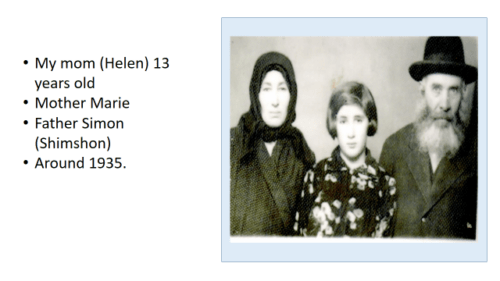
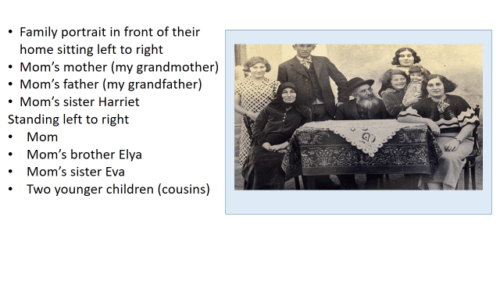
My grandparents had each been married before and their spouses had died. When my grandparents married they combined their children, and had five together, a blended family. They adhered to religious Orthodoxy, observed all Jewish holidays and kept Kosher. Kosher refers to foods that meet the dietary requirements of Jewish Law, which foods a person can and cannot eat, and which combinations of foods should be avoided.
There was a church near Mom’s home and there would be wedding processions to the church. Mom wanted to watch through the window, but her parents would not allow this.
There was not much money. There were only three items they had to buy: coffee, sugar, and tobacco. There was no indoor plumbing, only an outhouse. Mom fed the chickens and geese. She hated the geese because they were mean and would bite her legs. In the winter my grandmother would bring the baby chicks in the house and put them in a box by the stove to keep them warm. They were very noisy and constantly chirped. She cut up onions to put in the box and the fumes put them to sleep.
One of Mom’s brothers Elya loved the horses and would feed them, brush them and talk to them. Mom said the horses were beautiful, but she was afraid of them as they were big, she was little, and she was especially afraid when they reared up on their hind legs. He died at the Russian front.
The farm land was beyond the village. When her father worked the land, Mom would walk to where he was working to bring him lunch. Their house was in the small village and had a back room and they sold liquor out a window, which Mom helped serve.
Mom told me that one of her married sisters came home because her husband had beaten her. My grandmother took her in, fed her and let her stay the night, but the next day she was sent home to her husband. That was how it was at that time and place.
Mom could be feisty. Her parents invited potential suitors to the house for her to meet, but she did not want to get married and leave her parents. As they came in the front door, she would go out the back door.
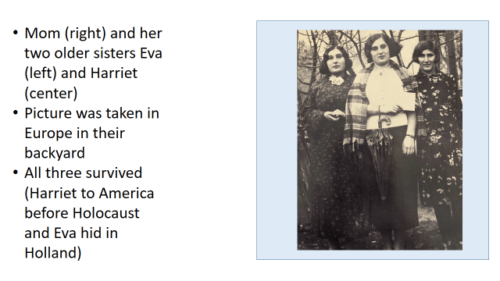
Mom’s two oldest brothers left home before she was born. Over time, other siblings left home. My grandmother would get mail with pictures and would cry and call them “mein papier kinder,” my paper children. Mom’s favorite sister Harriet asked to bring Mom to America with her before the Holocaust, but as Mom was the youngest of ten children and the last one at home she did not want to leave her parents.
As the situation became more dire, my grandfather was afraid to leave the house because men were forced to their knees and their beards cut off, so Mom would go out and do his errands.
When she was about 21 years old, in 1944, her village was invaded by Hungarian soldiers, who she described as very mean. They rode into the village with plumes on their hats, and their beautiful horses had plumes on their heads too.
The day before they were deported, the head of the village came to my grandparents’ home and told them the next day soldiers would take them away. My grandfather took Mom to the attic and showed her where he was hiding papers in the rafters. He told her, “mein kind” (my child), “Your mother and I will not come back, but you will.” I believe this was a verbal gift he gave Mom because she heard his voice and words in her head throughout her experiences. When she was liberated and returned home, she found the papers.
Before the soldiers arrived, Mom and my grandmother put on several dresses. The soldiers took each one into a room and told them to undress and wear only one dress. They painfully examined them naked for anything they might have hidden on or in their bodies, and Mom said it was painful. Mom was very sheltered and had never been naked in front of anyone before. She was very frightened and embarrassed enduring this dehumanizing experience. I could not bring myself to ask if she had been raped, and she never said. Maybe I didn’t want to know.
In the beginning of 1944, Mom with her parents and other family members were rounded up and initially deported to the Munkacs ghetto in a small town near them, Mukachevo, for approximately five weeks. They were then forced into a cattle car for deportation to Auschwitz. Upon arrival in Auschwitz Mom’s parents and family members were immediately murdered.
Conditions in the cattle car: Overcrowding, standing room only, no seats, no food and water, if they were lucky there was a bucket in which to relieve themselves which became nasty quickly. They could be in the cattle car anywhere from two days up to two weeks. Thousands died from starvation, dehydration and illnesses. These cars were not quiet, the prisoners were confused, terrified, yelling, crying, trying to console their children, pregnant women would go into labor. When the cattle car stopped and the doors opened, they had arrived in Auschwitz, the largest concentration camp in Poland, and camp prisoners herded everyone off the train car. They were told anyone holding a baby or small child should leave them with an older person or put them on the floor as anyone who did not give up their child would immediately be selected for the gas chambers. These camp prisoners were not being cruel; they were trying to be kind and save lives. But who could leave a child behind?
As they were herded out of the cattle car Mom had lost track of her father and other family members, but she was holding on to her sick mother’s arm. Dr. Josef Mengele was the senior official who made the selection and he used his baton to hit their arms and separated Mom from her mother and they went in separate directions. She never saw her parents and family again. When Mom asked where they were, she was told by other prisoners to look up at the sky, filled with smoke and ashes, and there was a sickening stench from burning flesh. Dr. Josef Mengele was one of the worst Nazis and known as the Angel of Death. He performed medical experiments on Jewish prisoners. He especially liked twins, triplets, dwarfs and gypsies. Nazi officials who made selections pointed in one direction for able bodied men, another direction for able bodied women. They had a chance to survive. Another direction for the old, the sick and the young who were useless as they could not become slave laborers and were sent directly to the gas chambers, and another direction for Dr. Mengele’s medical experiments.
Mom and others who became slave laborers were first sent to showers, deloused, and the hair all over their bodies was shaved. They were given thin uniform dresses, no underwear, and wooden shoes which caused blisters. If the blisters burst, they could become infected and lead to death, and many died.
Mom was about 21 years old and was selected for slave labor. When she got to her barracks she was crying. The Polish women asked, “Why are you crying? We built the barracks in rain and mud.” She never got over losing her parents under those horrific circumstances. For the rest of her life she always talked about and missed her parents and other family members. They haunted her. I grieved for her loss of family. I realize that Mom did not have the love and support of her parents. Growing up I felt the loss of not having grandparents.
The Auschwitz prisoners were given about one-half cup of so called “coffee” all day. The weather was very hot and they sat on the floor with no food or water. In the late evening they went back to their barracks. If anyone had to relieve themselves, they had to walk to the area and the water was rusty and caused diarrhea, resulting in many deaths from typhus. Mom did not want to live, she wanted to be with her parents. The other women told her that would not bring her parents back. After six weeks she was chosen to work. Roll call was taken twice a day and took 4-6 hours. Every morning and evening they had to stand five in a line and if the numbers did not match, it started over, and if they moved or talked they would be punished. For two days and nights Mom was with a group of women in a yard with no food or water and finally were ordered into a building where they were tattooed. Her arm tattoo number is A-7922. She was dehumanized because her identity was taken away, no longer known by her name, only by her number. Auschwitz was the only concentration camp that gave arm tattoos. Every morning she would leave the barracks to work, no matter how she felt, knowing that anyone who stayed behind was never seen again.
They were then sent to work. First Mom dug ground to tend to plants and pull weeds, which she was used to doing on the farm. One day a guard dressed in black, not the blue or green SS uniforms, beat her all over her body, in addition to 7-8 other women. Her wrist was badly hurt, probably broken, and very painful, but she had to continue to work or she would be killed. She tried to run cold water on it when she could and it eventually healed. The SS was the organization most responsible for the murder during the Holocaust of the approximate six million Jews.
One time Mom was very sick with a high temperature. Her face was very red and when a nurse walked through during roll call she was taken with a couple of other women to the hospital. The beds had no sheets, no mattresses, just a board. For about ten days she knew nothing. The other women told her the hospital did nothing for her. They were given only coffee and no food. One day Adolf Eichmann came into the hospital and told everyone “einshtallen,” stand up, and take their clothes off. There were two lines of approximately 300 women. Eichmann walked through the lines and selected three women to get out of line; Mom was one of them. The rest were told to go out a door and to get into Red Cross trucks, which turned out to be modified gas chambers using carbon monoxide gas. The three women were told to go to the right and go back to their barracks. As Mom approached her barracks the women inside looked out and said, “Are we dreaming?” “Is this Helen?” They thought they were seeing a ghost as very few prisoners survived the hospital. Eichmann was one of the worst Nazis. He was one of the main organizers of the Holocaust and was in charge of deportation to the death camps and he was very good at his job.
Mom then worked digging ditches and moved dirt to form a mountain, seemingly for no reason, and it was very hard physical work. She was then moved to another commander, she does not remember how, and was forced to dig very deep ditches and to put pipes in the ditches. If anyone stopped working the SS beat them with sticks.
One day a siren went off. The prisoners were counted and then had to run with dogs chasing them for several miles back to the camp, where they saw dead men in the grass, and the crematorium farther back among trees. Crematorium are ovens in which the dead Jewish bodies were burned. They heard later, they were not sure if it was true, that Jewish men working at the crematorium threw one SS guard in. The other SS guards killed all the other men working at the crematorium. Mom had a young cousin who worked at the crematorium who did not survive. Men who worked at the crematorium were murdered within six months and replaced.
Slave laborers who worked outside the camp like Mom were forced to march under a gate morning and night, sometimes with music playing, with the German words over the gate, “arbeit macht frei,” which means “work sets you free.” These words are very ironic, because I don’t think any of the prisoners believed their slave labor would set them free. Of course, the prisoners were accompanied by armed guards and attack dogs. Unfortunately Mom disliked dogs for the rest of her life.
Mom said that city women came off the trains wearing their city clothes, and then of course had to wear camp uniforms. In the summer they were not used to the hot sun and they would get blisters that would burst open and get infected, and many died. Mom did not get blisters as on the farm she was used to being outside in hot summers, as well as cold winters.
Mom did not remember how they knew it was Yom Kippur, the Day of Atonement, and a day for fasting. It is the holiest day of the Jewish year. Some prisoners decided to fast and not eat their lunch which consisted of some water and a little bit of foul smelling cabbage. A soldier in black clothes stood above them and for approximately 20 minutes made a speech, saying things like, “Why are you fasting? Nobody needs you and you don’t have a God. God does not see you, need you, or want you. You’ll all die here. You won’t be freed. You are useless people. He doesn’t care if you eat or not. Nobody will save you. You will work until you are dead.” He could have kicked their food over and they would have nothing to eat later, but he did not do so. They cried bitterly until there were no more tears. Another time a soldier made a speech about how they would never get out, there was no food, there was no God, and that they should give up and die.
In November 1944 the prisoners were forced onto a train for approximately two weeks. It stopped in Berlin, which they could tell from the small window, for a whole night and then started moving in the morning. The train stopped again and they heard bombing and saw the light from the window. The train was not bombed, but some tracks were. The soldiers left the train at night and the prisoners talked among themselves, figured the soldiers would find protection at night, such as bunkers, and they did not care if the prisoners died.
Mom was transferred to the Stutthof concentration camp located in Poland at the very end of 1944. She did not speak of what happened to her there.
Next, she was deported to the Ravensbruck concentration camp in Germany by train some time in 1944 and was there until the beginning of 1945. There were other Jews from Holland and France wearing regular shoes and clothing, they were not shaved, and some were still wearing make up. They were sick and the barracks were quarantined. The healthy prisoners were forced to collect the dead and take them outside. Mom did this only once and she passed out. Some of the new sick prisoners died after six weeks. The remaining sick prisoners had a lot of lice all over their bodies.
In the winter, December/January, the windows had no glass, Mom had no shoes and her toes were freezing from the terrible cold. There was no food, only coffee in the morning and evening, and no work, but Mom knew it was best to try to find something to do.
Mom developed an unbearable ear ache from the severe cold and biting wind. A nurse came a couple times a week and she was taken to the hospital. There they put her to sleep and cut her ear, covered it with a paper bandage which got wet from the infection and came off. She was released from the hospital. It was too cold to work and her ear hurt and got worse and started swelling. One day they were in line for their coffee and some of the women were noisy. Everyone was hit on the head to keep them quiet. Mom was hit on her ear and saw stars. This injury caused the ear wound to open and pus oozed out. She squeezed the infected area to get rid of the pus and eventually it healed.
One day Mom saw a woman from home who brought her some rags and strings to cover her feet. She always believed that if not for this, she would have lost her feet due to frostbite. Mom asked this woman if she knew anything about a sister. This woman said she saw the sister taken on the street by the SS and that she was not alive. I know this was very painful for her, and upon learning this it was painful to me.
Mom went back to work in a basement loading vegetables on trucks for the SS, and she was able to very carefully eat a little piece of vegetable now and then for a few weeks. She had to be extremely careful not to be caught. If she was caught she would have been punished which most likely would have been death. She wanted to bring some back for the other women, but did not dare do so as she could have been punished or killed. Another time she carried mattresses from one place to another in the camp. They wondered what happened to the women who never came back. Someone said they saw through a window some women sitting under cold showers day and night until they died.
Mom worked there until February/March 1945, and then approximately 300 women were loaded onto trains which did not take long to reach the Leitmeritz concentration camp, outside Poland and Germany, closer to Mom’s home in Czechoslovakia.
Mom arrived in the Leitmeritz concentration camp the beginning of 1945, which was a men’s concentration camp. A couple of barracks were emptied for the new prisoners and it was known they had a lot of lice. They stripped and their clothes were taken to bake in ovens to kill the lice and they had showers. No SS were inside the building, only outside. They had straw to lay on, which was unusual. They cried and were so happy they no longer had lice. Mom had marks all over her body from scratching. There was no work, and very little coffee and food.
After 3-4 weeks the prisoners were forced on a death march for a couple of days at night to the Theresienstadt concentration camp which Mom endured and survived. Mom had only rags tied to her feet. Consequently, she suffered from nerve damage caused by frostbite from walking in the snow, which resulted in chronic foot pain for the rest of her life. The prospect of possibly losing her feet deeply distressed and depressed her, and upon learning this, I was equally horrified.
Theresienstadt was a camp in the city of Terezín, located in German-occupied Czechoslovakia, which was even closer to Mom’s home. She later found out she was only 90 miles from Prague in Czechoslovakia, the closest city to her home. They were told to sit down on the grass by a giant gate. There were a lot of other women, a few hundred. The SS left them and went through the gate. Other soldiers opened the gate and told them to come in. They did not see SS soldiers, only other soldiers. There were approximately 40 women in a room with platform beds. Mom was told by a woman from Dad’s village that it was no longer a concentration camp. There was no food. Sometimes someone brought them some bread and for three weeks they only had crumbs. There was shooting and they were told to lay on the ground. The Russians were close. This lasted for three days and nights. The shooting stopped and they were told to get up, the war was over, and they were free. There were a lot of bullet holes throughout the building.
Theresienstadt was liberated on May 8, 1945 by Russian soldiers, the same day the Allies designated as Victory In Europe Day (V-E Day), the day Germany surrendered. Upon liberation, survivors asked the Russian soldiers for food. The Russian soldiers responded that they were hungry as well and all they had was “wodka” (Vodka). They were told to go down a road, cross a bridge to a town where the Germans had fled and abandoned their homes when the Russians arrived. They could go into the homes and take whatever they wanted and eat whatever they found. Many of these liberated prisoners ate food they found in the empty homes and got extremely sick and some died from “refeeding syndrome,” which is a condition that occurs when people who have been starved are reintroduced to food too quickly. Mom ate only bread and raw potatoes.
When they were liberated, the surviving prisoners were asked by the Red Cross if they had family members who could be located, as it could be arranged to send them to family. Mom said no because she wanted to go home to see if any of her family would return home.
Mom said it was hard to believe that a person could take so much punishment and still survive. She eventually made her way back to her village and after a while a brother, Harold, and a cousin, Sylvia, arrived. Mom and Dad met and they married in November 1945, and Harold and Sylvia married.
As I mentioned earlier, Mom could be feisty. She saw a woman on a wagon wearing her mother’s good scarf (babushka). She asked the woman to give her the scarf as she had nothing from her mother. When the woman refused, Mom went behind her and tore the scarf off her head and ran. Of course, she could have been punished for this. I had the scarf treated by a textile professional and framed. It hung in Mom’s bedroom, and now I am very pleased that it hangs in my bedroom. The scarf had been folded and kept in a small box for many years. When I took it out of the box under the scarf was the birth certificate of Mom’s favorite sister Harriet. Mom did not remember putting it there. We agreed that it belongs to my cousin, Harriet’s middle child, and gave it to him.
They decided to leave their village as they agreed it was not a life for Jews to live under the Russians, under communism. Uncle Harold, Mom’s brother, went to Prague and sent letters to Aunt Harriet in America, Mom’s favorite sister, and to Dad’s sister Esther in Pittsburgh, Pennsylvania. Responses, letters, money and packages were received. Harriet told Harold to bring the child (referring to Mom) and to make sure that she was not left behind. Esther signed an affidavit for my parents, and Harriet signed one for Harold and Sylvia. My parents and Harold and Sylvia entered America legally on the quota, as they had been sponsored. America allowed a certain number of immigrants to enter the country legally, the “quota,” if they had a sponsor who would sign an affidavit stating they would help with jobs and places to live so they would not become a burden on the American government. Harriet was like a mother to Mom and died at 47 from cancer, yet another loss.
It took them a long time to reach Prague, their point of departure. They crossed borders illegally as they had no documentation and were stopped a few times. They ran and hid from border guards. One time Uncle Harold was jailed. Dad found work for a few days and bribed the guards with rubles and he was released. They stopped for a while when my sister Miriam was born along the way in Czechoslovakia. At the time jets were used by the military only. Mom was almost nine months pregnant with me. I can only imagine how sick she must have been crossing the ocean in a propeller plane. They arrived in the United States the end of November 1948 and I was born in Pittsburgh, Pennsylvania, shortly after their arrival. When I was a few months old my parents with me and my sister took a train to Los Angeles and were met by Harriet. When Mom got off the train and saw the sun shining and her favorite sister she knew she would never move away from Los Angeles. My brother David was born in Los Angeles. The story of our births is part of the history of my parents’ emigration from their small rural farm villages to the beautiful city of Los Angeles.
The Russians did not allow them to take much out of the country, only a small amount of bedding and clothing.
Mom and Dad had to wait five years to become citizens. They attended night school to study for their citizenship exams, and they saw to it that my sister became a citizen when she was about ten years old.
An item of interest: Mom received a card from the German pension office regarding her ghetto pension congratulating her on her 90th birthday.
Mom and Dad were married for 56 years. I wear their wedding bands on a chain close to my heart. In 1995 we held a 50th anniversary brunch for them at the Milky Way Kosher restaurant on Pico Boulevard owned by Steven Spielberg’s mother Leah Adler. As my parents did not have a wedding cake, I arranged for a two tier wedding cake and Leah insisted on rolling it out on a cart and serving it herself. This was a very happy occasion and it was the last time all these family members and friends were together.
My parents’ legacy is they started a new life, had three children, two grand-children and three great-grandchildren. Their courageous survival is the reason for our existence. I am honored and grateful to be part of their legacy and to share their stories with future generations.
In conclusion, there is an increase in antisemitism and hatred. Education is so important so that the Holocaust is never forgotten. I read that evil will only be stopped when good people decide to put an end to it. Holocaust survivor Elie Wiesel often quoted a line from Leviticus, “Do not stand idly by while your neighbor’s blood is shed.” Another one of his quotes, “I don’t want my past to become anyone else’s future.” By standing up to antisemitism, injustice, bigotry, hatred, bullying, any type of persecution against anyone, you can make a difference. We hope you will be upstanders, and not bystanders. To quote from a pamphlet form the United States Holocaust Museum “Never again begins with you.” You can make a difference. We hope you will go home and tell your family and friends some of what you have learned here and pay the education forward so that the Holocaust is never forgotten.
Copyright © 2026 Deborah Zisovic Beckman. All Rights Reserved.