
My Father, Kalman Gutlohn – From Victim to a Heroic Survivor – Small Victories
by Mary Aviyah Farkas
Holocaust Survivors all have incredible, often unbelievable stories, at which people shake their heads and marvel. My father’s stories of survival are also unbelievable. This lack of belief in the things my father survived dogged him throughout his post Holocaust life. At the end of my father’s Shoah Testimony, which he gave 7 months before he died in 1986, he was asked: Did you talk about your Holocaust experience to anyone? He reluctantly replied,
“No, not too widely. All of my escapes and escapades,
even to me, I used to feel that people wouldn’t believe me.
I must emphasize that it was #1 – Luck, #2 – Luck,
#3 – Taking chances, #4 – When you take chances, you have Luck.”
Kalman Gutlohn, my barely five foot three inch, soft spoken, mild mannered father survived things which are difficult to believe. He took chances, small victories, which others would consider insane, and by taking those chances, he became a Survivor. He was a man who believed in himself, a man who quickly sized up situations, and trusted his gut instincts. My father had such faith in the fact that he would live, would survive the horrible, unspeakable events, that he took unbelievable chances. Maybe taking chances was his way of resisting the enemies of Jews. Maybe it was take chances or die? In a letter telling me some of his experiences during the Holocaust, he writes:
“I had a secret hope, should I say knowledge, that I will survive
all these bastards who were my enemies and the enemies
of progress…”
My father was born in 1910. He grew up in Budapest, became a banker in his twenties, married my Christian American mother in 1939, was fired from his job because of anti-Jewish laws, and along with approximately 100,000 other Hungarian men was taken into Forced Labor in 1941. His Labor Company, the 109/36 was sent to toil in the Carpathian Mountains putting up telegraph lines. Amongst the many brutal conditions of Forced Labor, the men were not issued uniforms, and had to find their own shelter. When the mountain weather became dangerously frigid, my mother’s Jewish employer, Paul Totis, was instrumental in saving the 200 men of my father’s Company by bribing Army officials to have the men moved back to Budapest where they now labored in the Goldberger Textile Factory. Men in forced labor would be given a three-hour leave, each six to eight weeks, and being back in Budapest, they were now close enough to visit their families. My mother could give my father warm clothing, good food and they even made my oldest sister, Victoria, named for Allied Victory. Had the men stayed in the Carpathian mountains, they would have frozen to death.
I will give you an example of my father’s taking chances, one of the dramatic escapes which saved his life. A Small Victory which allowed him to live.
When the Germans invaded Hungary, in March 1944, Paul Totis once again had the 109/36 Labor Company moved, from Budapest to the industrial area near Miskolc, believing they would be safer outside of the capital. There, they were put to work in the Hungarian Railroad foundry, without proper gloves or shoes to handle the red hot iron ore. When the Allies began their bombing raids in Axis industrial areas, the men were now tasked with clearing the streets of rubble and dead bodies.
On October 15, 1944, with the Szalasi-Arrow Cross coup, Admiral Miklos Horthy’s reign as leader of Hungary ended. The Christian commander of my father’s 109/36 Labor Company told the men, to “Just go home.” It was clear that Hungary was finished, the Russians had already entered eastern Hungarian cities and were on their way to liberate Budapest. For the men to “just go home,” meant that they had to cross the Bukk Mountains, in late October, early November, when it rained non-stop and Arrow Cross Terrorists were on the roads actively searching for Jews.
After three weeks of little food, constant rain and cold, traveling at night, hiding by day, the men made it back to the outskirts of Budapest and separated. It was safer not to stay together as a band of recognizable Jewish Slave Laborers. My father took off his yellow Forced Labor arm band, carefully got onto a trolley so as not to be noticed, and made it to his family’s apartment in Budapest. There my mother stayed with my 10 month infant sister Victoria. My paternal grandmother had already been forced to enter the Budapest Ghetto. My father spent one night with my mother, and in the early morning hours, he was picked up by Arrow Cross militants who were conducting door to door patrols looking for Jews to take to deportation gathering points. In Budapest, in early November, 1944, approximately 200 thousand Hungarian Jews still survived. A nice gift for Hitler.
These Arrow Cross patrols marched the Budapest Jews to a Brick Factory on the Buda side of the Danube. There my father was gathered along with the hundreds of others taken at gunpoint by the Arrow Cross. Inside, the Brick Factory was total chaos. People stood in utter confusion and shock in the pouring rain and thick, ankle deep mud. Families sought shelter, sitting on their suitcases, tired, hungry, forlorn and miserable. Women holding their children’s hand screamed out that they were Christians, then summarily shot. Instead of being packed onto cattle cars as transport, they were marched out, by the thousands, along the main highway leading to the Austrian border, having to walk the nearly 110 miles without proper shoes, clothing, food or shelter.
After my father was taken, my mother went on an anguished search for him. She learned which route the prisoners would take, and in desperation followed them, trying to find my father. In her post-war journal she writes:
“We saw the long column of deportees. Exhausted, rain soaked,
hungry, sleep-deprived people trudging along. Old women, young
girls, pregnant women, old men, strong young boys and men dragging
themselves in their long, long Calvary to an unknown fate. It was a
wretched sight; heart wrenching pale faces stared at us as we called
the names of the people we were looking for.”
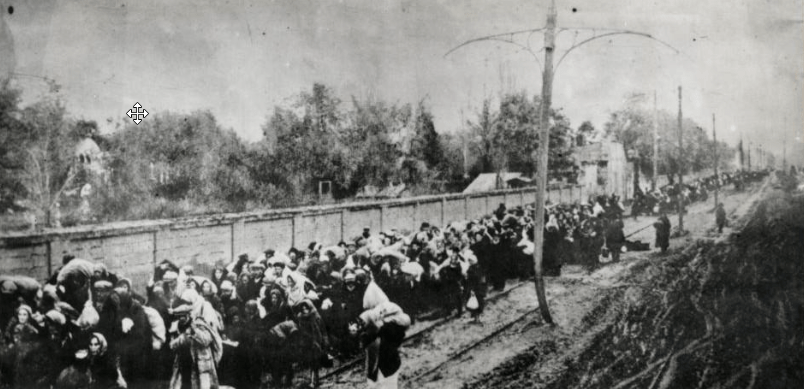
[photo credit: Death Blows Overhead: The Last Transports from Hungary, November 1944]
My mother never found my father amongst those destined for death. She had no idea that my father had been able to escape from the Brick Factory.
Once he arrived there, amongst the chaos, the mud, the utter confusion, my father knew, in his gut, that he would get out. He writes:
“If ever, this was an hour of taking chances or perish.
I approached a middle-aged benevolent looking [Hungarian]
Guard and asked him to transfer me to my unit from where I had
inadvertently strayed. I was lucky! The man was understanding.
Of course, he saw through my scheme. But in the confusion,
he stuck the bayonet on his rifle and marched me out from the Brick
Factory through the gates of Hell. A half hour later the two of us were
warming our frozen limbs in a friendly tavern sipping hot wine-toddy.”
From there, my father was able to obtain a Carl Lutz Schutz Brief (Safe Pass) and was able to enter a Safe House. In this Safe House, he had another unbelievably narrow escape, which I cannot tell you about now. But I want you to know….
How Lucky I am to have had a father who believed in himself, who followed his gut, who took unbelievable chances, and who had
#1 - Luck,
#2 - Luck,
#3 – He Took Chances,
and #4 – Had Luck Taking Chances
Copyright © 2026 Mary Aviyah Farkas. All Rights Reserved.