
Indomitable Spirit: A Father’s Legacy
by Andy Pasztor
Huddled in a rickety, horse-drawn farm wagon in the bitter pre-dawn cold, with flares furiously bursting overhead, I glanced up at the ashen faces of my parents.
Along with my mother Margit, father Erno and his sister, my aunt Elizabeth, we were sneaking across the Austrian border that night in late 1956, joining hundreds of thousands of desperate Hungarian refugees fleeing Russian Communist domination.
When I recall my experience as a six-year-old, I can still hear my parents reciting macabre stories about Soviet troops straddling tank turrets and yelling at passersby in Budapest, as they allegedly sought to abduct local kids.
Days after such frightening talk, the intense wind swirled past my head as I peered through the rickety floorboards. My cheeks and fingers lost all feeling. So did my feet, crumpled under me as we bumped along. My mother gripped my shoulders hard, pulling my head close to her as she agonized about potential land mines dotting the landscape.
Suddenly, the jostling stopped. None of us muttered a word as my father, convinced the cart driver was too drunk to remember where the border was, signaled we would walk the rest of the way.
The night was a blur, but nevertheless I sensed something dramatic, even momentous, was occurring as we stumbled through vineyards toward the silhouette of a dark farmhouse. His teeth chattering, my father directed us in a hoarse whisper to hide behind a clump of trees while he knocked on the door. If the occupants spoke Hungarian and detained him, he exhorted, “Keep going until you get to freedom. Don’t ever go back!”
The residents turned out to be Austrian, and they quickly escorted us to a nearby tavern converted into an emergency shelter for immigrants. From there, a kind Austrian doctor gave us train fare to join relatives in Vienna. It took my father months of standing in lines and filling out forms at the U.S. embassy to obtain required paperwork for entering the U.S. Eventually, we sailed into New York harbor on an aging troop transport ship, poised to begin a new life in America.
Throughout the months-long process, one thought preoccupied my young mind. How did that night’s ordeal on the Hungarian border compare with the harrowing Holocaust experiences my father had recounted back home.
Of course at that age, I could neither understand the nuances nor logically identify the parallels. But in retrospect, that sense of curiosity and wonder – driven by pride for my father’s invincible lifeforce – became the touchstone of my life.
Comparable narratives resonated inside my father, as well. Roughly 11 years after he was liberated from the horrors of Mauthausen, a concentration camp in Austria infamous for some of the worst conditions and most sadistic guards of the Nazi regime, my dear Apa was experiencing some of the same fears he confronted as a younger inmate.
Decades later as a U.S. citizen, he acknowledged the anxiety and terror were starkly similar. In unexpected ways, escaping his homeland revived memories of evading death at the hands of the Third Reich.
I was born in Budapest on June 22, 1949. As a child, young adult, middle-aged father and now senior citizen, those stories of Third Reich atrocities, Hungarian immigration and American renewal became entwined and forever etched in my memory. What combination of willpower and happenstance allowed my father to survive, and eventually thrive, despite so many devastations over many decades?
Gut-wrenching cold, such as the experience along the Hungarian border, was a fixture in my father’s World War II memories. Born in Budapest in 1914, Hungarian Nazis dragged him away from his family as a 29-year old. He often described serving for two years before Mauthausen in an all-Jewish forced labor battalion. The unit was attached to the Hungarian army and supported German troops on the battlefield.
The malnourished men, however, were transported to Ukraine and other front-line combat zones without weapons or proper uniforms. Even scrawny horses that pulled logistics carts driven by Jewish conscripts were given substandard food. After all, one aggressively ignorant sergeant told my father with a smirk, “they are all Jewish horses, after all.”
Lacking adequate winter clothes and missing gloves, deciding when and how to urinate became a huge challenge for members of the battalion. As my father explained with a wry smile many years later, the temperature frequently was so cold that by the time you opened your trousers and relieved yourself, exposed fingers could get frostbite. Then it was impossible to rebutton or otherwise close your pants.
Once he arrived at Mauthausen, camp guards provided even more fiendish surprises. Minor infractions such as arriving a couple of minutes late for mandatory morning roll call typically prompted severe punishment. The favored method was to tie the offender’s hands and feet behind him, hoist him on top of a tree and spray him with water. If it was cold enough, the frozen cadaver would remain hanging in the camp’s central courtyard for weeks. It was just another excruciating reminder of who was in charge. A horrendous way to humiliate helpless Jews, my father later fumed.
Mauthausen, near the city of Linz, was a killing camp but also the site of an elaborate stone quarry. Many inmates were crippled while lugging huge granite slabs, some weighing more that 80 pounds, up a steep incline. Dubbed “The Stairway of Death,” it had some 180 steps leading to a ridge overlooking a deep valley.
Unfortunate victims were exposed to a different but equally merciless tactic dubbed “The Parachute Line.” Guards kidded and laughed with each other as the torture unfolded. Jewish men were ordered to line up in two rows, overlooking the chasm. Those in the rear were ordered to push the person in front of them to certain death. Inmates who refused were shot on the spot, and guards rolled their bodies onto the jagged rocks below.
When my father harkened back to nights sleeping in the camp, there were times he saidit evoked the memories and sounds of his Hungarian border crossing. Fright and uncertainty were constant companions, Rustling vegetation and labored breathing merged into an ominous hum.
At Mauthausen, Jews were forbidden to talk or even whisper during the night. But that didn’t mean all was quiet. Today one camp survivor’s quotes about those eerie dark hours are prominently displayed for visitors on the walls of a “lager,” or communal sleeping quarters. Once the order for silence was issued, this survivor recalled, it kicked off a “concert of wheezing and hissing, coughing fits, belching and farting, snoring in several pitches, soft moaning and sobbing.” The background noise “fused into a single, horrible sound as if produced by a giant, monstrous being that had holed itself up in the dark.”
Mauthausen was liberated just days before Germany surrendered to the Allies. U.S. Gen. George Patton’s tanks and other forces, fast-moving brigades rushing to capture Berlin, didn’t know precisely how to deal with thousands of near-death inmates.
Commanders lacked the tools or patience to manage them. So senior officers left behind plenty of rations, limited supplies of antibiotics and a few American soldiers to triage survivors. Medics issued strict warnings to temporarily limit nourishment, because perforated stomachs and intestines couldn’t process the food.
Hunger, however, proved too daunting an enemy. Despite surviving the war, overcoming Mauthausen’s brutality and being barely a three-hour train ride from surviving parents, wives and children, dozens of my father’s friends couldn’t control their food intake and inadvertently died gorging themselves.
Others considered too sick to benefit from drugs were relegated to die in one squalid section of the camp. That’s where my father found himself in the summer of 1945, suffering from typhus accompanied by an extremely high fever. The only reason he didn’t succumb to the disease, my father explained later, was thanks to a well-meaning Hungarian cook working for the U.S. Army. My father made friends with this good Samaritan, who returned the favor by serving up several thick slabs of chocolate to his new-found buddy.
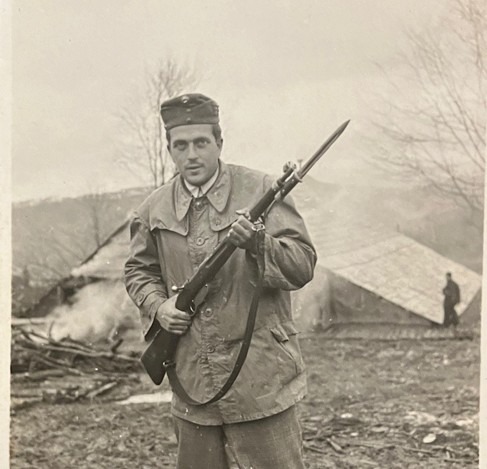
The fever broke, medics doled out some drugs and Erno Pasztor, emaciated but unbowed, managed to don a discarded Italian soldier’s uniform to hop on a train back home.
He found Margit, my future mother who survived the Third Reich hiding out with a non- Jewish family, and learned that many relatives, including his father, Arthur, and Dezso, a beloved uncle, had been deported months before and perished in Auschwitz.
As an only child, I grew up immersed in Holocaust narratives and anecdotes. Year after year, my parents talked about the era with fellow survivors, fondly recalling deceased relatives and viciously attacking long-dead Nazi officials.
There were somber stories always told in Hungarian, punctuated by descriptions of seemingly idyllic extended family weekends before World War II. From my elementary and high school days, my best friend was the only child of Austrian survivors. When I visited his house, there were endless discussions of the same kind, except mostly in German. As a college student, the only subject that truly captured my interest was 1930s and 1940s German history.
My father, who died in September 2008 at the age of 94, recounted his experiences until his last days.
Regardless of how much one reads about the Nazi era or studies accounts of historians, the fundamental truth remains elusive: how was it possible so many people were complicit and stood by silently while all the atrocities occurred?
Scholars have complex theories to explain what happened: desperate striving for social cohesion; group dynamics of conformity; impressionable Nazi youth groups; deference to authority; altered moral norms. There are many more terms, but none more salient than virulent antisemitism.
But for me, none of them truly explain the horrors my father and so many others lived through, or the millions who didn't survive.
Now I give Holocaust museum tours, spreading lessons from his indomitable spirit to as many young people and adults as possible.
Copyright © 2026 Andy Pasztor. All Rights Reserved.