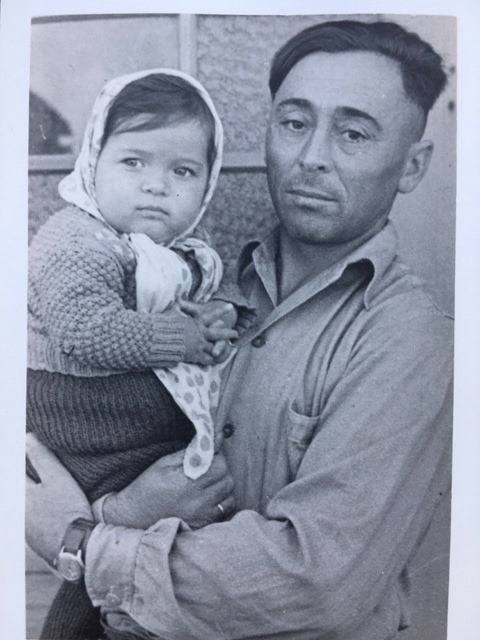
“Mein Tayereh Tateh”, My Beloved Papa, Shimon “Sam” Paikow, z”l
by Anna Paikow
I am a daughter of Holocaust survivors. I am a member of Second Generation. I was born in a
Displaced Persons Camp after the war. I am an only child. I am blessed and forever grateful ~ to carry forward the legacy of my beloved parents, who miraculously survived the Shoah in Eastern Europe.
My family history is heartbreaking, inspiring, and enriching. Heartbreaking, because nearly everyone in my parents' families were murdered in the "killing fields" near Sarny, Wolyn, western Ukraine in August 1942. Inspiring and enriching because of how, after the "Shoah", my parents chose to live their lives, and how they transmitted to me their life-affirming values, ethics and belief in a better future, in a good life, in a life full of kindness and generosity. They never took anything for granted, and neither do I.
When I first learned that Papa was diagnosed with terminal cancer in Summer 1987, I panicked. I realized that we had only a few years left to be together. I wanted to learn so much more about his heroic life. I wanted to "share" his extraordinary story of survival, of fighting back, of saving lives, and of building a "new" life for "us" after the war.
I began to do oral history interviews, first with a cassette recorder and later, during our visit in Israel ~ with a video camera. Our trip to Israel was emotional for both of us, because Papa was saying "Hello" and "Goodbye" to family and good friends ~ for the last time.
It was often difficult to hold the video camera still ~ when I heard stories that were tragic and overwhelming. After we returned to Los Angeles, a good friend helped with the interviews. She held the camera while I sat next to Papa.
Both Papa and Mama were "more open" about answering certain questions when a friend joined us. Some questions were left unanswered, and I understood why. Their efforts to "protect" me from knowing "too much" about "der milhomeh" = "the war" ... were especially significant because I was their only child.
During the interviews, Papa spoke most powerfully about fighting back, about saving lives. For Papa, these were the most important reasons for living after what he had witnessed.
The night before Papa died, I held his hand tightly, kept my face close to his, told him how much I loved him, and promised that I would tell his story. I continue to keep this promise as a museum docent, as a "DOR" = "Descendants of Remembrance" speaker, and thanks to Michele Gold and our writing workshop, as an author of a memoir.
Papa was born in Klesov, a small town in the province of Wolyn, also known as Volynhia in western Ukraine. Jews worked in farming and in various trades. Papa's family had a small farm and a flour mill.
Pre-World War II Klesov, like many small towns throughout Eastern Europe, had a vibrant Jewish community, with many educational, cultural, religious and politically progressive programs and institutions. For example, there were several active Zionist youth groups. Papa belonged to Beitar, a right-wing Zionist youth movement, founded by Ze'ev Jabotinsky. Papa's younger twin brother and sister, Sender and Hannah belonged to HaShomer Ha-Tzair, a socialist Zionist youth movement. Imagine the heated discussions at home. When Papa's younger sister, Hannah visited us two years before Papa died, the arguments about Israeli politics were loud and heated nearly every day, until I, a Labor Zionist, made the peace.
During the period of Soviet control, from 1939-1941, Papa served as a Klesov Town Council representative, and soon after, enlisted in the Soviet Army. My parents told me that before Nazi Germany took control of Eastern Europe in June 1941, they, for the most part, lived in "peaceful co-existence" with their Ukranian non-Jewish neighbors. They also understood that the situation could very quickly change for the worse.
In Klesov, Papa's close friends were both non-Jewish Ukranians and Jews, and later, during his years in the Soviet Army, his best friends were non-Jewish Russians. Anti-Semiticism was pervasive and deep-rooted throughout Eastern Europe. In the late 19th and early 20th centuries, the well-documented horrific pogroms against Jewish communities were devastating.
Violent and hostile outbursts also occurred among and between Ukranians, Russians, Poles, Germans, Jews, and other national and ethnic communities. For example, during WW II, Ukranians committed vicious pogroms against their Polish neighbors.
It is also important to consider the geopolitcal history of Ukraine, which has been a complicated one for hundreds of years, as various powers took control and changed territorial borders. During the 20th century, the ruling powers were the Russian Empire, Poland, the Soviet Union, Nazi Germany, Soviet Republic of Ukraine, and as of 1991, the independent nation of Ukraine, which in recent years has been defending itself against Russian military aggression.
As a result of this "geopolitical" history, Papa was "multi-lingual". He spoke, read, and wrote in several languages ... Russian, Ukranian, Polish, Yiddish, some German, and after we immigrated to and settled in the U. S., English and some Spanish.
The songs Papa most loved to sing were in Russian. Russian music resonated deeply, because Russian was the language Papa "lived in" during the years he fought as a Partisan and as a soldier. During our interviews, Papa would answer certain questions only in Russian, again because during the war years, this was the language he "lived in" and vividly remembered.
In June 1941, Nazi Germany broke its Non-Aggression Pact with the Soviet Union and invaded Eastern Europe. German forces quickly advanced through Eastern Europe and took control of a huge area which was formerly Soviet-governed and which included a population of more than 3,000,000 Jews.
During his military service in the Soviet Army, Papa had learned about the Einsatzkruppen,
the "mobile killing units" that swept through the Soviet territories of Eastern Europe alongside Germany's military battalions. In most cities, towns, and villages, Jews were first forcibly removed from their homes and imprisoned in ghettoes, where living conditions were miserable. Their homes and all their possessions were "taken" by their neighbors. Imprisonment in ghettoes was short-lived. Mass murder quickly followed.
The Jewish communities of Eastern Europe were the first victims of the "Final Solution."
In Eastern Europe, more than 2.5 million Jews were murdered by the Nazis and local collaborators, bullet by bullet, and buried in mass graves, many of which have no markers. In Ukraine, more than 1.5 million Jews were murdered.
In the province of Wolyn where my family had lived, less than 1% of the Jews survived,
either in hiding, or by fighting as Partisans or as soldiers in the Soviet army, or by escaping to Eastern Russia and to the Soviet republics in Central Russia. The names of more than 50% of the "innocents" murdered in Eastern Europe remain unknown. Their names are missing from Yad Vashem's archives.
Papa's regiment was disbanded after it was defeated by the Nazis in the Battle of Kiev in September 1941. The surviving soldiers destroyed their uniforms and military documents, and rushed back to their towns and villages to warn their families and friends of impending disaster.
Papa, dressed as a Ukranian farmer, returned to Klesov and found all the Jews imprisoned in a ghetto. He explained to everyone what he knew and had seen, and tried to convince them to save their lives by escaping to the surrounding forests, where they would hide and "hopefully" survive. In other parts of Eastern Europe, Jews, with the help of Jewish Partisans, had already done this. Ex. ~ The Bielski Partisans and Family Camp in the forests near Minsk, Belarus.
In the Klesov ghetto, everyone was exhausted and frightened. They had been beaten, abused, and forced to do dangerous work for the Germans. There was little food, medical supplies, and other necessities. They did not have the strength to escape. Several friends and family members had already been shot and killed. Papa could have left, since he was dressed as a Ukranian, but did not. He stayed, knowing full well what would soon happen.
In August 1942, all the Jews from Klesov and from nearby towns were forcibly taken to several prepared mass grave ravines on the outskirts of Sarny, where they were brutally shot at close range, face to face or in the back. Many Jews were shot and killed as they were forced to march to the prepared grave sites.
The Ukranians "mostly" did the shooting. The Germans gave instructions, supervised, and watched. The shooting continued for two full days. Historians write that more than 15,000 Jews were murdered. I believe many more Jews were murdered in the Sarny Massacre, because it is impossible to gather precise statistics about the genocide in Eastern Europe.
Many Ukranians welcomed the Nazi invasion in June 1941, and were eager to collaborate and commit mass murder against their Jewish neighbors. Ukranians believed that by helping Nazi Germany win the war, they would be assured of Ukraine becoming an independent nation after the war ended.
Papa was shot several times, but miraculously did not die. He pretended to be dead, and lay still in a mass grave together with his murdered wife, his murdered young son, his murdered relatives and his murdered friends.
I was never told that Papa had had a wife and a young son ... until many years after my parents died. A close family friend, who was also a survivor, had known Papa's wife and son before the war, and told me about them when I interviewed her. I teared-up, and tried to imagine what Papa's wife and son looked like. We had no photos.
I researched the Yad Vashem archives for murdered relatives whose family names were Paikov, and I found the names of Fryda, z"l, Papa's first wife, and of Shaya, z"l, Papa's young son. I added both names to my Genealogy Tree, and my Family Tree grew.
Papa waited until late at night when he, along with several other wounded survivors, managed to crawl out of the graves, naked and bleeding and reach the nearby forests. Papa limped his way to the home of a good friend, a Ukranian farmer, whom he trusted. This friend, who was anti-Nazi, could hide Papa for only a few days, because it was dangerous to help Jews. The Germans and local collaborators threatened death to anyone and often to the entire family when they discovered that Jews were being hidden and cared for.
After Papa's gunshot wounds were cleaned and bandaged, the farmer made contact with a local anti-Nazi Soviet Partisan group. Because Papa had been a soldier in the Soviet Army, he was airlifted to a military hospital in Moscow, where his wounds were treated and where he regained his strength. Papa was then trained in partisan warfare, and several months later, was airlifted back to Sarny, where he organized a group of Jewish Partisans to fight against the Nazis and their Ukranian allies.
I wish I knew more about the farmer who helped Papa. I would have submitted his name to Yad Vashem to be honored as "Righteous among the Nations". This brave man possessed the precious qualities of compassion, kindness, and the courage to care.
Jewish Partisans in Eastern Europe fought to avenge the murders of their families and friends, and of all the destroyed Jewish communities. Papa, like many Jewish Partisans, helped hide and save the lives of many Jews who had managed to escape from the ghettoes and from the killing fields to hide in the forests.
There are several written articles and oral testimony videos, in which friends, whose lives were saved, and friends who fought together with Papa, describe his bravery and kindness.
The Shimon Paikov Brigade is mentioned many times.
Brenda Senders, z"l, whose life Papa saved, wrote that "Shimon was a natural leader. He knew how to acquire guns, ammunition, food, clothing, and medicine for the Jewish refugees he was hiding in the forests." Brenda added, "the Ukranian villagers knew and feared him." My Papa was fearless.
In recent years, the Shoah in Eastern Europe has been called "The Holocaust by Bullets". Beginning in 2006, Father Patrick Desbois and his organization, "Yahad-In-Unum" = "Together as One", traveled throughout Ukraine ~ to interview witnesses of the mass murder that occurred in their towns and villages. These witnesses had been young children, aged 8, 9, 10, 11, 12 during the war. Since Father Desbois was a priest, witnesses felt more comfortable answering his questions.
In addition to recording the interviews, Father Desbois and the volunteers of Yahad-In-Unum identified and authenticated more than 2,500 unmarked execution sites and mass graves of murdered Jewish victims in Ukraine. Many of these mass graves have no monuments or markers to remember and honor the dead.
The history of "industrial murder" is incomplete without explaining that millions of Jews were killed ~ where they lived in the most brutal of ways. Holocaust education programs and history museums need to give more attention to the Shoah in Eastern Europe. I hope that in our future expanded museum, more history will be provided, and that the nearly 3,000,000 Jewish victims of the Shoah in Eastern Europe will receive the commemoration that they deserve.
After the Soviet Union launched its counter-offensive military campaign against Nazi Germany, the majority of the partisans in Eastern European were "absorbed" into the Soviet Army. Papa fought as a soldier and as an officer in many battles ... all the way to the Battle of Berlin and the end of WW II in Europe on May 8, 1945.
After the war, Papa returned to Sarny. He looked for and found several of the Ukranian murderers that had killed his family, friends and Jews from neighboring towns. Papa had witnessed who did the shooting and who did the supervising during the Sarny Massacre of 1942, and decided to "take care" of the murderers. The Soviet authorities "looked the other way".
In Sarny, Papa met Mama, who, except for one cousin, was the only survivor of her large family. They soon married. When I asked Mama how she met and married Papa, she replied, "Hitler was the matchmaker !" Mama had a "sarcastic edge".
Even though Papa was honored as a war hero and was given an important position by the Soviet authorities in Sarny, both he and Mama decided to leave. They could not forget the vicious hatred and violence that they had experienced and witnessed. Most importantly, they could never forget that their family and friends were buried in mass graves after being executed for one reason - they were Jewish.
Papa and Mama knew that life for the Jewish people would never be secure in this part of the world. They had heard about the Displaced Persons Camps for survivor refugees in the Allied occupation zones of Germany, Austria, and Italy. Since the war had recently ended, most borders were open, and it was easy to "leave". A few items were packed, and Papa and Mama left by train.
I was told that when they stopped in Poland to change trains, Polish people held up hateful
anti-Semitic signs and yelled from the train terminals that they had not finished Hitler's work. My heart sank when I heard this, and I understood why my parents were determined to get as far away as possible from Eastern Europe.
I was born in Hof Displaced Persons Camp in southern Bavaria in late 1946. We lived in two other DP camps, while waiting for visas to immigrate. It took more than 4 years of waiting. Mama had found a cousin, Morris S. in Detroit, Michigan, who agreed to sponsor our immigration. He completed and signed all the necessary government documents.
Even after the end of WW II, and even after everyone knew about the mass murder of Jews in Europe, the U. S. continued to be an anti-semitic nation, as evidenced by how difficult it was for Jewish refugee survivors to obtain visas and immigrate. Quotas continued to be in full force.
We finally received our visas, and before the end of December 1950, we arrived in Ellis Island, New York Harbor, along with several thousand Displaced Person Refugees on the USS General C.C. Ballou, a military transport ship that had been converted to bring refugee immigrants with visas to the U. S., Canada, and several other nations.
Mama's cousin met us at Ellis Island, and together, we traveled by train to Detroit. We began a new life. Both Papa and Mama found work. We joined a local synagogue. Our friends were also survivors, and together, we welcomed each other into our apartments, where we celebrated friendships, holidays, and traditions. We attended weddings, bar mitzvahs, and other "simchas".
I remember asking my parents several times if they believed in G-d. They looked far away and answered that they didn't know. And I understood. What they did know is that they wanted to keep and celebrate their Jewish traditions not only as a community, but as a way to honor and remember their murdered families.
In 1956 we became proud U. S. Citizens. Papa and Mama always stood up to recite the Pledge of Allegiance. They enjoyed singing patriotic songs, even when they didn't know all the words. They hummed the melodies and smiled. Papa and Mama sang and hummed beautifully.
Copyright © 2026 Anna Paikow. All Rights Reserved.