Music in the Key of 2G Minor and 2G Major
by Anna Paikow
A precious ingredient in my DNA identity and heritage as a Second Generation daughter of Shoah survivors is my love of music, all kinds of music. I still have my music album, cassette, and cd collection of more than 300 titles. I began purchasing albums at age 12 ... with my babysitting earnings.
My parents, "of blessed memory", enjoyed listening to music, especially Yiddish and Russian music. They also sang beautifully. Imagine singing after what they had witnessed and experienced.
For my parents, as for many survivors, enjoying music provided a life-affirming connection with their pre-Shoah lives, their families and friends, their Jewish culture and traditions.
I smile when I remember Momma singing while she was cooking and baking in the kitchen and while she was pedaling away on her vintage Singer sewing machine. I smile when I remember Papa singing prayers in "shul" = synagogue, at home during the Pesach Seder, welcoming and celebrating Shabbat and other holidays, and at Wolyner Society (organization of survivors from the province of Wolyn, Ukraine) celebrations.
After receiving an award at a Wolyner Society Gala honoring my parents, Papa began singing “Yerushalayim Shel Zahav” = "Jerusalem of Gold" to an audience of more than 100 survivors and guests. He was beaming as he sang. The President of the Wolyner Society put her arms around Papa and encouraged him to end, but he would not. She and another member had to gently nudge Papa off the stage.
A year before Papa died, he was invited to sing in our synagogue's Men’s Choir during High Holiday services. He looked so happy on the “bimah” = stage, and I felt so happy for him.
Both my parents loved the song, “Katyusha”, a Russian folk melody and military march, which Mama told me was sung by Soviet Army soldiers when they arrived to liberate the towns, cities, and camps in Nazi-occupied Europe.
Several years ago, I marched in a May 8th parade, celebrating the end of WWII in Europe in 1945. When the participants around me began to sing “Katyusha”, I was all smiles. This was the song that alerted Mama that the Soviet Army was near, and that soon she would no longer have to fear being caught and killed by the Nazis or by their Ukranian supporters.
Soon after immigrating from Displaced Persons camps to the United States at the end of 1950, my parents purchased a radio. What a treasure that was! Several years later, I joined the chorus at our local elementary school. The school gifted each of us a one-octave recorder. We performed “The Ballad of Davy Crockett" and “Yankee Doodle” at a school concert. I continue to serenade family and friends “Happy Birthday” tunes on this trusty recorder, my very first musical instrument.
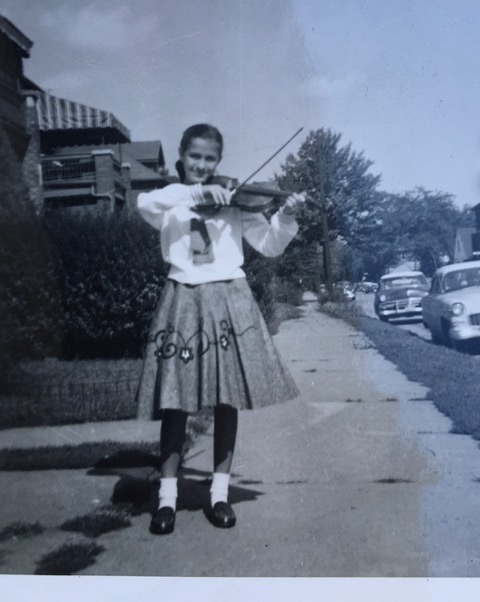
When I was 11 years old, my parents purchased a second-hand violin and encouraged me to enroll in a school orchestra class to learn how to play. I performed with our elementary and junior high school orchestras. Papa and I shared the violin. He would often play Russian and Yiddish melodies “by ear”.
The last time I played my fiddle was several years ago when, after obtaining permission from the medical staff, I serenaded a friend in the hospital. After squeaking through a few songs, my good friend, Fernando, “of blessed memory”, smiled and patted his heart in appreciation.
During my senior year at Fairfax High School, I sang “Soon It’s Gonna Rain” from the Broadway musical, “The Fantastiks” in our springtime musical production. I went off key “only” twice. Years later at a high school reunion, one of my classmates remembered my singing and said that she had always admired my “chutzpah”. I smiled, thanked her, and replied that singing was in my family DNA. My beloved parents miraculously survived the Shoah, loved to sing, and “chutzpah” was very much in their DNA.
I often sang during the 25 years I taught at Fairfax High School. I sang at faculty meetings, retirement and birthday celebrations, in classrooms and in the Drama class’ production of the musical, “Grease”. Nearly every week, I sang a short “promo” on the school’s public address system about various student educational and career internship, community job and volunteer programs. A student once asked who would continue singing after I retired. I smiled and answered, “perhaps you will”!
In March 2009, I was one of several women honored by the City of West Hollywood with its “Women in Leadership” award. I concluded my acceptance speech by singing a favorite song, Bob Dylan’s “Forever Young” as a tribute to the youthfulness and social activism of West Hollywood, which in 2009, celebrated its 23rd birthday.
At my retirement party, which was held at Canter’s Deli, I sang in both English and Hebrew. In addition to other courses, I taught Hebrew as a foreign language, so it was ok to sing a Hebrew song. I sang, “Ani veh Atah” = “I and You”, a song about creating a better world ~ together.
During my spoken eulogy at Mama’s funeral service, I sang the Yiddish songs,“Kinder Yoren” and “Mein Yiddishe Mameh”. I chose “Kinder Yoren” = “Childhood Years”, because it was one of the songs that Mama sang when she was busy sewing. “Kinder Yoren” was composed by Mordecai Gebertig, a wonderful Yiddish poet and songwriter who was killed by the Nazis in the Krakow Ghetto in 1943.
I love the Yiddish term, “mameh loshen”, the "language of one’s mother". I read that when we speak and sing in Yiddish, in our “mameh loshen”, our hearts both cry and rejoice. So true.
In recent years I’ve sung at several "Celebrations of Life" for close friends who have “left us”. I believe that my friends smiled when they heard my singing a tribute song to their lives.
Before the Shoah and during the Shoah, music provided a profound source of spiritual, cultural, intellectual, and physical resistance. Orchestras, choirs, and other musical groups were formed in many ghettos. Performances were often clandestine. In some ghettoes and camps, such as Theresienstadt and Auschwitz, celebrated and renown Jewish musicians were permitted to create and perform music for inmates and for Nazi officers, soldiers and guards. The survival of these Jewish musicians was short-lived, as nearly all were soon murdered.
In the book, The Inextinguishable Symphony, Martin Goldsmith writes about the Kulturbund = The Jewish Culture League, which was created in Nazi Germany in 1933. Jewish musicians were permitted to present concerts of music created by Jewish composers for Jewish audiences. Jewish musicians were forbidden to perform music composed by Germans or perform in German orchestras. The Kulturbund, which also staged theatrical performances, was a cultural refuge for thousands. It was disbanded by the Nazis in 1941, and nearly all of its members as well as nearly all the Jews still living in Nazi Germany were sent to the camps.
In the ghettos of Poland and Lithuania cabaret music thrived. “Makeshift” clubs and theaters were created for Jewish people to listen to Yiddish songs, as well as to European operetta, American ragtime and Argentine tango. One of the first anthologies of songs from the Shoah period, Lider fun di getos un lagern = Songs of the Ghettos and Camps was published in 1948. The songs were collected and edited by the Vilna poet, author, teacher, and partisan fighter, Shmerke Kaczerginski,.
Among the many Jewish music albums and cd’s that I treasure are “Ghetto Tango Songs" and “Rise Up and Fight”, a compilation of Jewish Partisan songs that was produced by the U.S. Holocaust Memorial Museum. Papa, z”l loved to sing “Zog Nit Keynmol” = "Never Say ...", “The Partisan Anthem”, composed by Hirsh Glick, a poet and partisan fighter, who was born in Vilna. He was killed fighting the Nazis.
Many Shoah-themed films and documentaries portray heroic stories about Jewish composers and musicians. One example is “The Pianist”, which won the Best Picture Oscar in 2003. Sheet music composed by Jewish victims and survivors of the Shoah that was discovered in former ghettoes and concentration camps continues to be performed in concerts around the world.
In recent years, the "Violins of Hope" project has presented concerts in which musicians perform on violins, violas and cellos that were once owned by Jews before and during the Shoah. These instruments have been brought back to life by father and son, Amnon, z"l, and Avshalom Weinstein of Tel Aviv. The instruments are symbols of hope and renewal.
I share my DNA love and creation of music with relatives in Israel. Cousin Hasida is a classical pianist and instructor of classical piano and “halil” = recorder at the Israel Conservatory in Tel Aviv. Cousin Shaike, z"l, was a celebrated composer and lyricist. Quite a few of his songs accompany Israeli folk dances.
Dancing is also most definitely in our DNA. At "simchas" such as weddings, b’nai mitzvoth and other celebratory events, our survivor friends loved to dance. Many would have been first place winners on the television program, “Dancing with the Stars”.
Papa’s bullet wounds, inflicted when shot in a mass grave during the Shoah, did not stop him from dancing at simchas. He danced with great rhythm and style and a serious limp. For many years Mama suffered from bad arthritis, and yet, at every simcha, she enthusiastically joined the “hora” dance circle. Survivors danced to feel joy. They embraced dancing because they didn’t know what might happen tomorrow.
For many years, groups with little or no Jewish background have been performing wonderful "Klezmer" music and singing Yiddish songs with nearly perfect Yiddish accents at festivals around the world. These international traveling troubadours not only create good vibes, but most importantly, they create good will.
Music elevates us and spreads joy and light. It builds bridges between diverse communities, and reaches across divisions ~ into people’s hearts and souls.
I love seeing the smiles of friends listening to, and even better, singing and dancing along with me. I continue to dance, sing, play the recorder, the kazoo and my violin, after I get it tuned, to create joy and laughter.
I am forever grateful to my beloved parents, “of blessed memory”. Our musical DNA welcomes everyone, “leh dor veh dor” = “from generation to generation”.
Copyright © 2026 Anna Paikow. All Rights Reserved.