
Keeping Watch
by Howard Schattner
August 2025
Preface:
I was born in New York City on August 20, 1953. My father, Meschulim “Max” Schattner was born in February 1906 in Zablotow which, at that time, was part of Poland. He and his family moved to Vienna in approximately 1914 and then relocated to Berlin in approximately 1927. Very early in the morning of October 28, 1938, Max and his brothers Bernard and Jacob were forcibly taken from their apartment in Berlin as part of the so-called Polish action, and deported to Poland. Because they were officially considered Poles, the public prosecutor’s office prohibited them from staying in Germany. The brothers managed to get new passports in Krakow, and then fled to Antwerp. Around the time the Nazis conquered Belgium, in May 1940, Max and his brothers fled to Marseilles where they lived in hiding until they managed to enter Switzerland, illegally, on October 4, 1942.
In Switzerland, the Schattner brothers were housed in six different locations under the supervision of the VSJF, the Swiss Jewish Refugee Relief Organization: Wald, Corbeyier, Beatenberg, Meringen, Clarens, and Dietikon. During their stay they were trained in pattern-cutting and for a short time Max was employed as an intern at a clothing manufacturer. Finally, after several years of failed attempts to immigrate to the United States, Max left Switzerland for New York on August 16, 1947. Brothers Jacob and Bernard followed on October 26, 1947.
My father didn’t share with me any stories about his life in Europe before coming to America. I didn’t learn about his history until I was an adult and became curious. The first bit of information I discovered was the fate of my grandfather, Chaim, and aunt, Jente. I found records of them on the Yad Vashem website. Chaim died in the Theresienstadt concentration camp in December 1943. In May of 1944, Jente was transported from Theresienstadt to Auschwitz where she was murdered upon arrival.
My father, Meschulim “Max” Schattner, who died in 1977, never spoke to me about his parents. They weren’t in my life, and I never asked him about them. One may wonder why. Perhaps I sensed, without being consciously aware of it, that broaching this subject would be painful for him, given their fate. I did, however, learn about my paternal grandparents many years later.
*****
In June of 2012, my wife Anastasia and I travelled to Berlin to attend the installation of Stolpersteine for six members of my family. After the final two of those six memorial stones were placed in the ground, the ones for my paternal grandfather and aunt whose lives, I had discovered, ended in concentration camps, I had a brief chat with a German woman, Monika Wirth, who was present during the installation. She informed me that she had done research for Jewish people who were interested in finding out more about ancestors who had lived in Berlin and had died at the hands of the Nazis. I told her that I didn’t know anything about the fate of my grandmother, Ester Schattner. Could she help me? Monika offered her assistance, and I accepted. A few weeks later, I received an email from her informing me that my grandmother, whose maiden name, I now learned, was Scheiner, had died in August of 1942, that she was buried in the Weissensee Jewish Cemetery in Berlin, and that she had visited my grandmother’s grave. This news came as quite a surprise!
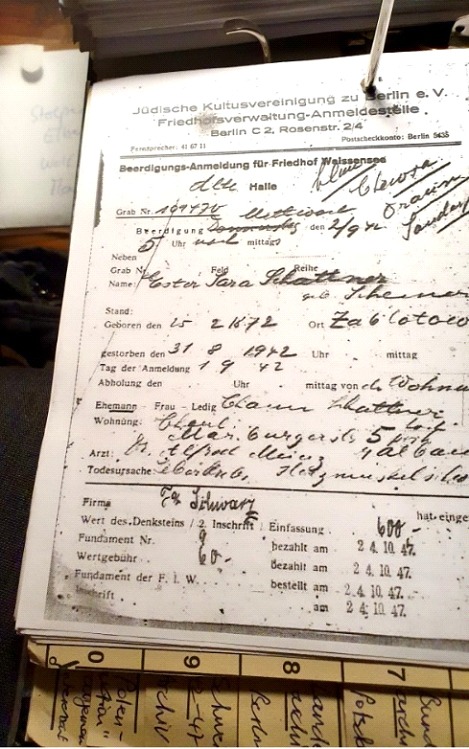
Page one of my grandmother’s newly discovered death certificate.
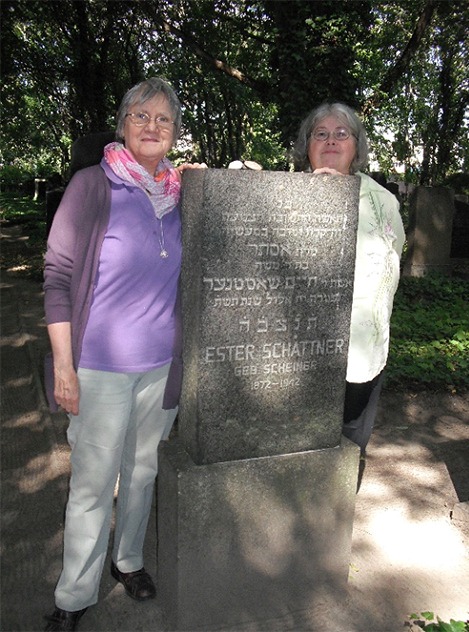
Monika Wirth, on the right, with a friend, behind my grandmother’s tombstone.
Since learning of the final resting place of my grandmother in 2012, I have visited her grave four times, during four subsequent trips to Berlin. The upcoming trip in 2025, the fifth, would be different from all the rest because I was planning to bring with me the 1940s era, Swiss wristwatch my father had worn for more than thirty years, the one material object in my possession that connected me so strongly to him. It had lived, and I had observed it, on his left wrist for so many years that it seemed like a part of him, as if it contained a small particle of his essence.
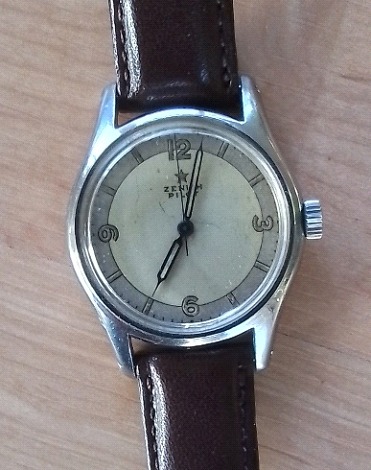
My father’s Zenith wristwatch.
For a long time, I wondered what to do with this special watch. I have no children to leave it to, and I don’t want it to be thrown away or sold at an estate sale. Shortly before leaving for Germany in May, I decided on a plan; I would bury the watch at my grandmother’s gravesite.
On May 25th, Anastasia and I, and my dear German friend, Renate Kratschmer, drove to the Pankow district of the city where the Weissensee Cemetery, the largest active Jewish cemetery in all of Europe, is located. Upon entering the grounds, we were presented with a very sad sight, a Holocaust memorial commemorative stone, surrounded by smaller stones with the names of the twenty- three main concentration camps where millions of Jews had been murdered. Although I had seen these stones before, they never failed to remind me of the tragic fate of so many innocent people, people very much like me.
With Renate leading the way, because she had been here many times before, the three of us walked silently through the cemetery, passing tombstones and grand mausoleums in various states of disrepair. It was obvious that many of the Jews buried here must have lived successful and prosperous lives and hoped to rest, for all eternity, in comfortable and majestic enclosures, reminiscent of the stately homes they may have once lived in.
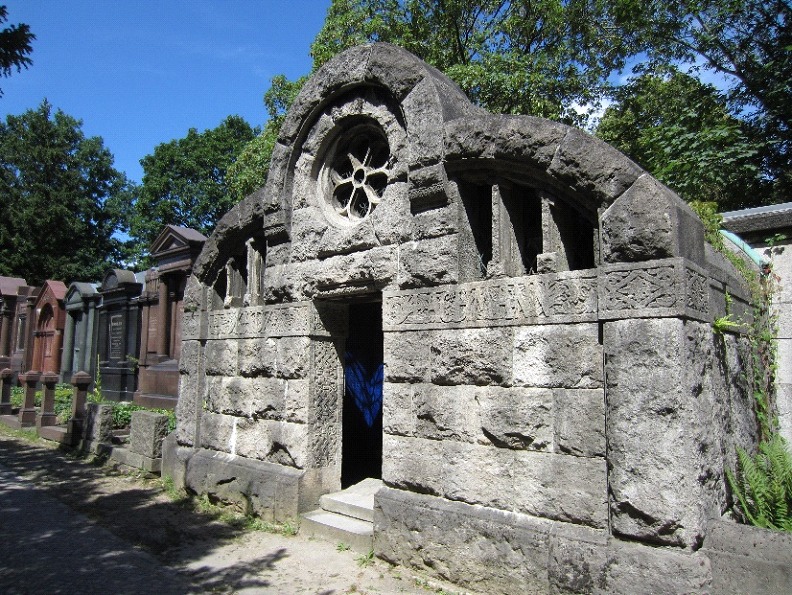
One of the many mausoleums, this one still in good repair.
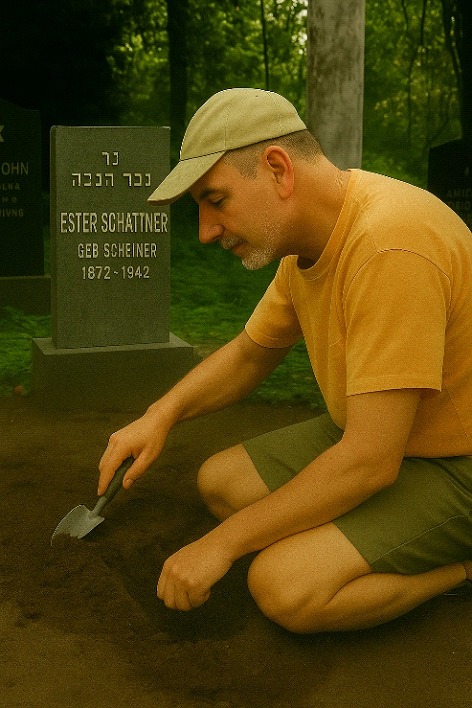
Upon arriving at my grandmother’s burial place, we each placed a stone on her tombstone to memorialize our visit, and then, with my companions standing somberly behind me, I knelt down. With the gardening spade I brought with me from California, which in the past had only been used to plant flowers and dig weeds, I dug a small hole, eight inches deep.
One of the many mausoleums, this one still in good repair.
In it, I placed my father’s watch, which I had coated with three layers of plastic to protect it from rusting, just above where my grandmother’s coffin was carefully interred at the beginning of September 1942, shortly after her death. Was I being foolish or naïve in wishing that this simple act would reunite mother and son, eighty-seven years after their abrupt separation when in the early morning hours of October 28, 1938, my father and his two brothers were arrested and expelled from Germany, three of the seventeen thousand Polish Jews who suffered the same fate? I hoped not. As we retraced our steps, walking in silence towards the cemetery entrance, I felt lighter, as if a heavy burden had been lifted off of me, knowing that I had succeeded in completing the mission I had long dreamed of.
*****
It's the end of August, less than three months after our return home from Germany, and an email arrives in my in-box. It’s from Ancestry.com informing me of a second cousin I had never heard of, and there’s a message:
Hello Howard, I just started on this platform and I’m trying to figure out where we are connected in our family trees. Kindly reply. With thanks, Ellen.
Over the years, I had researched and collected much information, and copies of documents from various archives, pertaining to my father and the Schattner side of the family, but I had never once given any thought to my grandmother’s, the Scheiner, side of the family. This newly discovered second cousin, according to DNA analysis, is Ellen Badinelli, a Scheiner descendant. My grandmother, Ester, and her grandfather, Max Scheiner, were siblings born seventeen years apart, Ester in 1872, and Max in 1889.
*****
Timing is everything in life, people say. That old maxim comes to mind when I consider that up until now, shortly after I turned seventy-two, I knew nothing about, or even considered that I may have, undiscovered, living relatives from my paternal grandmother’s side of the family. And then, shortly after our return from Germany where I completed my long-dreamed-of mission to symbolically reunite my father with his beloved mother, her great-niece appears in my life, as if out of nowhere. Did the act of burying my father’s watch at his mother’s gravesite bring about this result, and the beginning of a possible reunification of descendants of the Scheiner side of the family? Did it open an unseen door, or set invisible gears in motion for this amazing discovery? That’s a question I will have to ponder, although I may never know the answer.
Copyright © 2026 Howard Schattner. All Rights Reserved.