Anna’s Precious Legacy
by Anna Paikow
I am the daughter and only child of my beloved parents, "of blessed memory", Matel "Mary" Schechet Paikov and Shimon "Sam" Paikov. Both my parents miraculously survived the Sarny Massacre, where more than 15,000 Jews from my parents' towns as well as from neighboring towns were murdered in August 1942.
Beginning with the success of Nazi Germany's invasion, known as Operation Barbarossa, in June 1941, Jewish communities throughout the Soviet-governed lands of Eastern Europe were systematically exterminated. From 1941 - 1944, more than 2,000,000 Jews were murdered and buried in mass graves in what is now identified as the "Holocaust by Bullets".
Mama was born in Berezhnitza and Papa was born in Klesov, both small farming communities located in the province of Wolyn / Volynhia in what is today, western Ukraine.
My parents' survival stories are heroic. Mama escaped from the Berezhnitza ghetto the day before all the Jews were to be forcibly transported to Sarny, to be murdered. She hid in the nearby forests, then arrived at the home of a Ukranian family friend, who, at great personal risk to himself and to his family, agreed to help her. This friend acquired Ukranian i.d. documents for Mama, taught her how to pray in church, and instructed her to get as far away from Sarny as possible. She was to tell people that she was looking for work and that she was an orphan, which was true, since her entire family, except for one cousin, had been murdered.
Mama was always on "high alert". Whenever she felt that her true identity might be discovered, she packed a small bag with some food and clothing and moved on to the next town. Mama was "on the run" until late October 1944, when the Red Army liberated this large area of Eastern Europe.
Papa's story is especially incredible and heroic, because he actually "rose from the dead", from a mass grave in Sarny, naked and bleeding ... to fight back as commander of the Shimon Paikov Partisan Brigade and later as a soldier and an officer in the Red Army.
I am forever grateful to the Ukranian friends who had the courage to care and helped my parents survive. May their memories forever be a blessing.
After the war, my parents returned to Sarny, where they met and soon married. Even though Papa was an honored and respected war hero and had been given a government position in now Soviet-governed Sarny, Mama and Papa decided to leave. They had heard about the Displaced Persons ( DP ) Camps in the Allied-occupied zones of Western Europe. They packed a few bags and traveled to the DP Camps in Germany. The borders were open and "fluid", and survivors were determined to get as far away as possible from the vicious hatred, violence, and horrors they had witnessed and suffered. They could never forget that their family and friends were buried in nearby mass graves after being executed for one reason only ~ they were Jewish. Papa and Mama knew that life for Jewish people would never be secure in this part of the world.
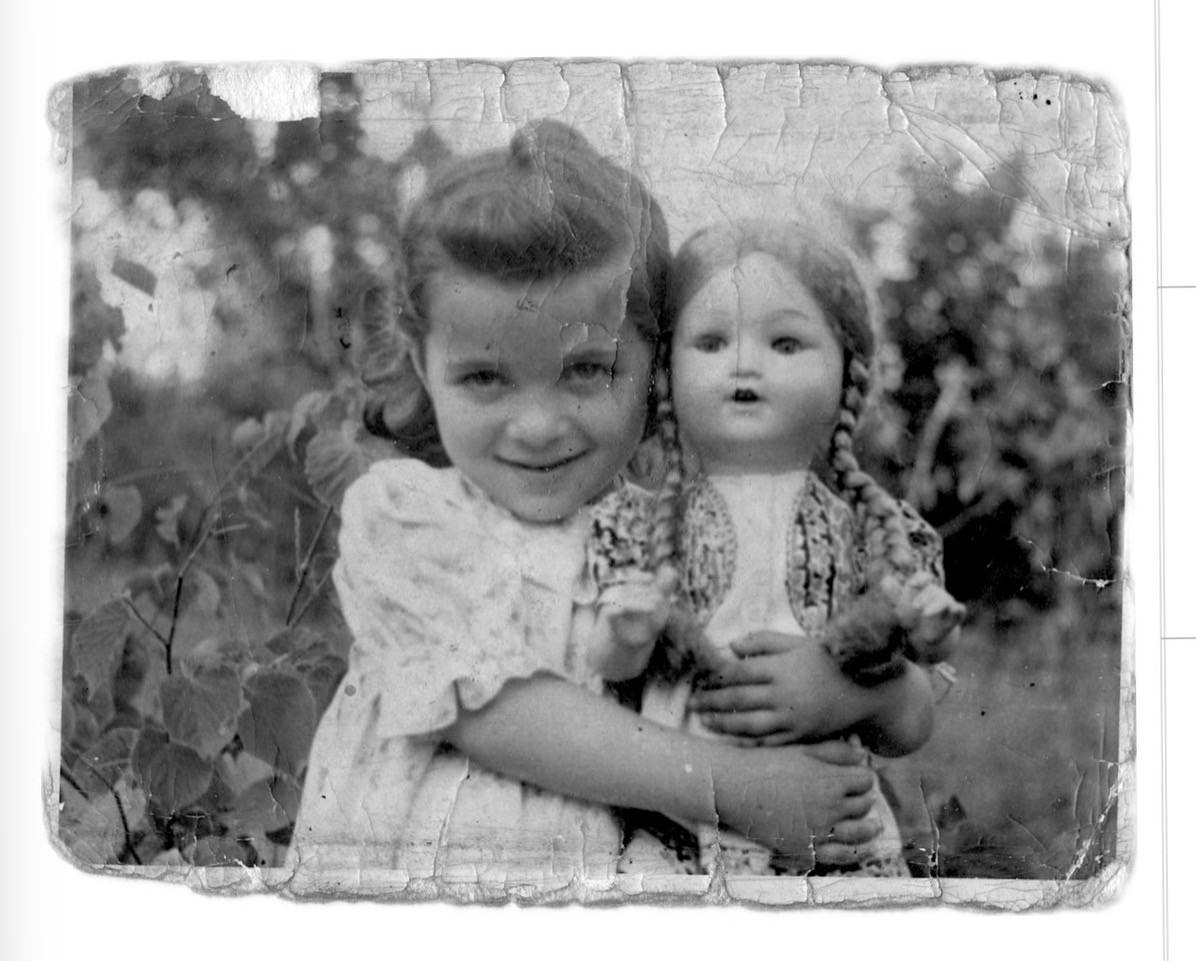
I was born in Hof DP Camp in Germany. In addition to Hof, we lived in two other DP camps. We lived together with several other families in dormitory-style converted German military barracks. There was very little privacy.
My first language was Yiddish. I was told that survivors enjoyed speaking Yiddish with me. I was also told that I was adventurous and mischievous and that my parents often had to ask for help to find me whenever I wandered off to explore and play with other children.
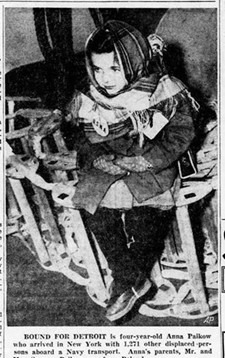
After four years of waiting, we finally received visas to immigrate to the United States, and at the end of December 1950, we arrived at Ellis Island in New York Harbor. We were met by Mama's cousin, Morris S., who had completed the required documents to sponsor our immigration, and together, we traveled to Detroit, Michigan.
Cousin Morris helped us find a small apartment in the downtown area. Mama and Papa soon found work and began to learn English, and the following year, I began to attend Kindergarten classes at a local public school.
Like my parents, I was a refugee immigrant. I knew that we were different from our neighbors. At school, I knew I was different from my classmates. I was very shy, and worried that my English didn't sound "right'. My name, "Anna" was foreign-sounding, and I often introduced myself as "Ann". After my spoken English improved, I became less shy and made many friends.
I loved going to school. I loved learning. I loved going every week with Papa to the local public library to borrow books to read. I often borrowed more than ten books at a time. Papa helped carry most of the books.
All of our friends were survivors, and together with their children, we celebrated holidays and simchas. Our friends were our close family.
In addition to Cousin Morris and his family, Mama found several cousins who lived in other cities. Like Cousin Morris, their families had immigrated to the U. S. in the early 1920's. They were "Americans", and we were "deh greeneh" = "the green ones", the new immigrants. It would have been wonderful if they had lived close by, so that we could have been a closer family.
I didn't like being an only child. I wanted brothers and sisters. When I asked Mama, "why we didn't... ?", she looked at me with sad eyes and answered that she didn't want to talk about the topic. Years later, I learned that it had been very difficult to care for me in the DP Camps. At age two, I nearly died from diptheria. I was also very ill on the transport ship that brought us to the U. S. Mama feared having another child.
Growing up, I knew very little about my family history and "deh milhomeh" = "the war". I also understood that I shouldn't ask certain questions. Mama and Papa were overly protective, and believed that it was not good to know about what happened during the war. They wanted me to have a happy and secure life.
I visited Israel for the first time after graduating from university. In Israel, I began to learn a great deal about my parents' lives, our family history, and the Shoah. I met my uncle and aunt, Papa's twin siblings, who had immigrated to British Mandate Palestine in the mid-1930's, and their families and friends. I met friends whose lives were saved by Papa during the Shoah. It was emotionally overwhelming to listen to the stories, to learn the names of my murdered relatives, to see family photos that I had never seen before.
I volunteered on a kibbutz, learned Hebrew, and became friends with kibbutz members who were also survivors. I visited Yad Vashem for the first time.
During my second visit to Israel, I attended the Hebrew University of Jerusalem as a graduate student. I became friends with students who, like me, were also "2G's", Second Generation children of survivors. I continued to learn.
After Papa was diagnosed with terminal cancer, we decided to visit Israel together. Papa came to say "Shalom", both "Hello" and "Good-bye". This was his last visit. I brought a video camera to film and record conversations between Papa, our family and the friends whose lives he had saved. After we returned to Los Angeles, I continued to film interviews.
Mama was very reluctant to speak about what she had experienced and witnessed. She would look at me and angrily reply, "Why do you need to know this? What difference does it make?" Papa readily talked about "fighting back" and "saving lives", but was also reluctant to discuss painful topics. Several times when he did answer a difficult question, he would look away and tear up.
For a long time, I've understood that life is not secure, especially for Jews. In recent years, the explosion of verbal hostility and physical violence against our Jewish communities, both here and abroad, has strengthened my determination and commitment to speak, write, and educate.
I've also understood that despite their horrific experiences during the Shoah, my beloved parents found the strength to embrace their identity, their traditions, their heritage, and most of all, their commitment to helping others.
"Mir darfen helfen menschen" = "We need to help people" ... was my parents' "mantra". They emphasized, "we lived, because someone helped us." Mama and Papa helped their neighbors, their friends, their family, and they volunteered for organizations, both here and in Israel. I carry forward this precious legacy.
I've "thrived" as a volunteer for many organizations and events during my student, professional, and retirement years. I've thrived as an educator for much of my professional life, and in recent years, I've thrived as an HMLA museum docent, speaker, and member of our wonderful Shoah Legacy Writers group.
I believe that when we share personal family histories, we strengthen the bonds that connect us with others, both within our Jewish community as well as with neighboring diverse communities I believe that together, we can and will create and nurture a more caring, respectful, just, and equitable society.
Marek Edelman, z"l, one of the leaders of the Warsaw Ghetto Revolt wrote that the most appropriate way to memorialize the past, the Shoah, is through how we live our lives today.
May the memory of my beloved parents, Matel and Shimon Paikov continue to be a blessing and an inspiration.
Copyright © 2026 Anna Paikow. All Rights Reserved.