Liberation
by Anna Paikow
"Liberation" is a powerful theme in our history. On many Jewish holidays, we celebrate victory and liberation from oppression, from slavery, from danger, from death and destruction.
Survivors of the Shoah, their children, and grandchildren, typically think of liberation from nearly six years (1939-1945) of brutal combat and destruction, mass murder and genocide, when forces of the Soviet Union, Great Britain, and the United States liberated countries that had been occupied, governed, and terrorized by Nazi Germany and its Axis allies.
This quote from Rabbi Sharon Brous captures that moment. “The idea that it’s possible to move from slavery to freedom and from darkness to light and from despair to hope . . . that is the greatest Jewish story ever told.”
In the narratives of my beloved parents of blessed memory, "liberation" occurred several times.
In August 1942, both my parents miraculously survived the mass murder "aktion" in Sarny, now western Ukraine.
Mama was born in Berezhnitza, and Papa was born in Klesov, both small farming towns located in the province of Wolyn. Pre-World War II Klesov and Berezhnitza, like many rural settlements throughout Eastern Europe, had vibrant Jewish communities. In the years before WWII, Jewish and non-Jewish neighbors, for the most part, lived in relative "peace" in these towns. However, the Jewish inhabitants knew full well that "co-existence" could quickly change for the worse.
Papa told me that his close friends were both Jewish and non-Jewish Ukranians, and that later, in the Soviet Army, his best friends were non-Jewish Russians.
Except for one cousin, Mama was the only survivor of her large family. She miraculously managed to escape from the Berezhnitza ghetto the day before all the Jews from her town and surrounding communities were forcibly transported to the larger town of Sarny, to be murdered. Shots were fired at Mama and other ghetto escapees, as they fled to the nearby forests and marshes. Many were killed as they ran. Amazingly, Mama was not killed.
Mama was the youngest in her family and not yet married. Her older siblings were married with children, and could not run to escape. They were all murdered in Sarny.
After hiding in the forest, Mama arrived at the home of a non-Jewish Ukranian family friend, who, at great personal risk, agreed to help her. He let Mama stay in his home for several days, obtained false I.D. documents, taught her how to pray in church to avoid detection, and then directed her to get as far away as possible from the Sarny area. Mama was instructed to tell people that she was looking for work and that she was an orphan, which was true, since her entire family, except for one cousin, had been murdered. This courageous Ukranian friend was a "liberator".
Mama was always on "high alert". Whenever she felt that her true identity might be discovered, she packed a small bag with some food and clothing and moved on to the next town. She was on the run until late October 1944, when the Red Army "liberated" this large area of Eastern Europe. Mama told me that when she heard the song, "Katyusha", a Russian folk song, she knew that Russian soldiers had arrived to liberate Lutsk, the town in which she was hiding.
Mama packed a small bag and returned to Berezhnitza, and later to Sarny, hoping to see if anyone she knew had also survived.
Papa fought as a soldier in the Soviet Army before the Nazi invasion of Eastern Europe in June1941, but his regiment was disbanded after it was defeated in the Battle of Kiev that September. Papa returned to Klesov to warn his family and friends of impending disaster.
During his military service, Papa had learned about the Einsatzgruppen, the "mobile killing units" that swept through the Soviet territories of Eastern Europe alongside Nazi Germany's military battalions. In cities, towns, and villages, Jews were forcibly removed from their homes and imprisoned in ghettoes. Imprisonment was short-lived. Mass murder quickly followed.
Papa tried to convince his family and friends to escape from the ghetto into the forests. However, they were exhausted and too frightened to escape. There was little food or other necessities. Several friends and family members had already been killed. Papa could have left, since he was dressed as a Ukranian farmer, and the local population feared him, but he did not. Papa stayed, knowing full well what would soon happen.
In late August 1942, all the Jews from Klesov and nearby towns were forcibly taken to prepared mass graves on the outskirts of Sarny, where they were shot. Papa was shot several times, but miraculously did not die. He pretended to be dead, laid still in the mass grave, and waited until late at night. He crawled out, naked and bleeding, to escape into the surrounding woods.
Papa arrived at the home of a good friend, a Ukranian farmer, who helped save his life. This friend could hide Papa for only a few days, because of the wartime dangers for the farmer and his family. After Papa's bullet wounds were cleaned and bandaged, the farmer made contact with a local anti-Nazi Partisan combat unit. Here again, a courageous Ukranian friend helped to "liberate", helped to save Papa's life.
Papa was airlifted to a military hospital in Moscow, where his wounds were treated. After regaining his strength and receiving specific military instructions, Papa courageously returned to the Sarny forest area to set up a partisan brigade, which became known as the Shimon Paikov Brigade.
During the years he fought as a partisan, Papa saved the lives of many Jews who had escaped from ghettoes and killing fields to hide around Sarny. Papa once told me that fighting back and saving Jewish lives were the only reasons he wanted to live.
Several years later, during the Soviet Union's counter-offensive against Nazi Germany, the majority of the Partisans were absorbed into the Soviet army. Papa fought in many major battles in the western advance to Berlin. "Liberation" describes Papa's life as a partisan fighter, a Red Army soldier and officer, and a rescuer of Jews.
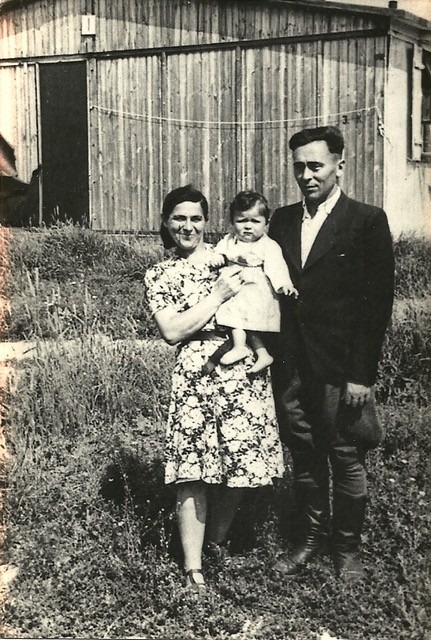
After the war ended, Papa returned to Sarny, where he met and married Mama. Even though Papa was an honored war hero and had been given an important position on the city council, Mama and Papa decided to leave Sarny, and travel to the Displaced Persons (DP) Camps in the post-war U.S. occupation zone of Germany. Neither one could ever forget that their families and friends had been brutally murdered and lay buried in nearby mass graves ~ for one reason only ~ that they were Jewish.
Mama and Papa left Sarny in December 1945 and arrived at the Hof DP Camp in January 1946. I was born in Hof in late 1946.
In addition to Hof, we also lived in the Deggendorf and Lechfeld DP camps. After waiting nearly four years, we finally received visas to immigrate to the United States. Mama had found a cousin, Morris Schwartz, who lived in Detroit, Michigan, and who agreed to sponsor our immigration. He completed and signed all the necessary government documents. Cousin Morris was our immigration "liberator".
At the end of December 1950, when we arrived at Ellis Island in New York Harbor, the Statue of Liberty greeted us. We were now "liberated" refugee immigrants. A newspaper photographer took me aside to take my photo as representative of a young immigrant arriving from the D.P. camps in Europe. My parents were frightened. They didn't speak English and didn't understand what was happening. Someone came to explain in a language they understood, so my parents calmed down.
For many years, Papa kept a newspaper clipping of this photo in his wallet, but then lost it. Many years later. I took a Genealogy workshop and mentioned this lost photo during one of our meetings. Miraculously, our teacher quickly found it on newspapers.com. I now had my first "liberation" photo.
After completing the immigration entry process at Ellis Island, we met Mama's cousin, and together we traveled by train to Detroit, where we began a new life. "Liberation" now meant finding a place to live, finding work, putting food on the table. We joined a local synagogue. Our friends were also survivors, and together we welcomed each other into our small apartments. We celebrated holidays, weddings, bar mitzvahs, and other "simchas".
Less than a year after we arrived, I began kindergarten. Going to school, learning how to speak a "decent" English, singing in the school choir, and making good friends ... were all "liberating.” In 1956, we became proud U. S. citizens, a truly "liberating" event.
In Fall 1959, we moved to Los Angeles. There had been a bad economic recession in Detroit, and Papa, who worked as a carpenter, had been out of work for nearly a year. With the help of our survivor friends, who had already moved from Detroit to Los Angeles, we found a place to live, and soon, both Mama and Papa found employment.
As in Detroit, most of our friends were survivors. We joined a local synagogue, and Mama and Papa became active members of the Wolyner Society, a landsmanschaft organization of survivors who came from Wolyn province. Mama and Papa volunteered as Vice Presidents, of whom there were quite a few. The "Wolyner" supported charities both in this country and Israel.
On most Sundays, my parents and their survivor friends enjoyed visiting with each other in the Palisades Park area in Santa Monica. They would set up tables and chairs, spread blankets on the grass and, of course, bring enough food to feed friends and strangers alike. To enjoy such friendship outdoors -- to speak English and other languages without fear or worry -- while smiling and saying hello to passersby, all of that was “liberating.”
As I reflect upon my life as the only child of my beloved parents, "liberation" has and continues to be a powerful gift and motivating legacy and force.
After receiving my B. A. degree, I went to Israel to study, volunteer, and teach English. Mama and Papa visited me, our relatives and friends on two separate occasions. Visiting Israel, a nation that had declared its independence in 1948 -- and had successfully fought for and continues to fight for its survival -- was “liberating” for us as it has been for many others.
Papa passed away in 1989, and Mama passed away in 2007. They were and are my heroes. My life continues to be enriched with their "liberating", life-affirming values, and especially, their commitment to helping others. "Mir dafen helfen menschen" translated to "we need to help people," was not only my parents' motto; it was their "raison d'etre", their "reason for living". As they explained, "we lived because someone helped us."
Among the many "liberation" experiences and events that have been gifted to me are the following: receiving an outstanding academic education; participating in a variety of school and community volunteer activities; working various part-time jobs during my student years as well as teaching and counseling for nearly 40 years during my professional work years. Most importantly, "liberation" has meant celebrating life together with my beloved parents, with my family in the United States and in Israel, and with my many wonderful friends.
I believe we "liberate" ourselves by helping and caring for others, by helping to create more respectful, just, and equitable communities. I also value and live by the motto, "Keynmol nisht fargessen,” translated it means "never forget."
May the memory of my beloved parents, Mary "Matel" Schechet Paikov and Sam "Shimon" Paikov continue to be a blessing and an inspiration.
Copyright © 2026 Anna Paikow. All Rights Reserved.